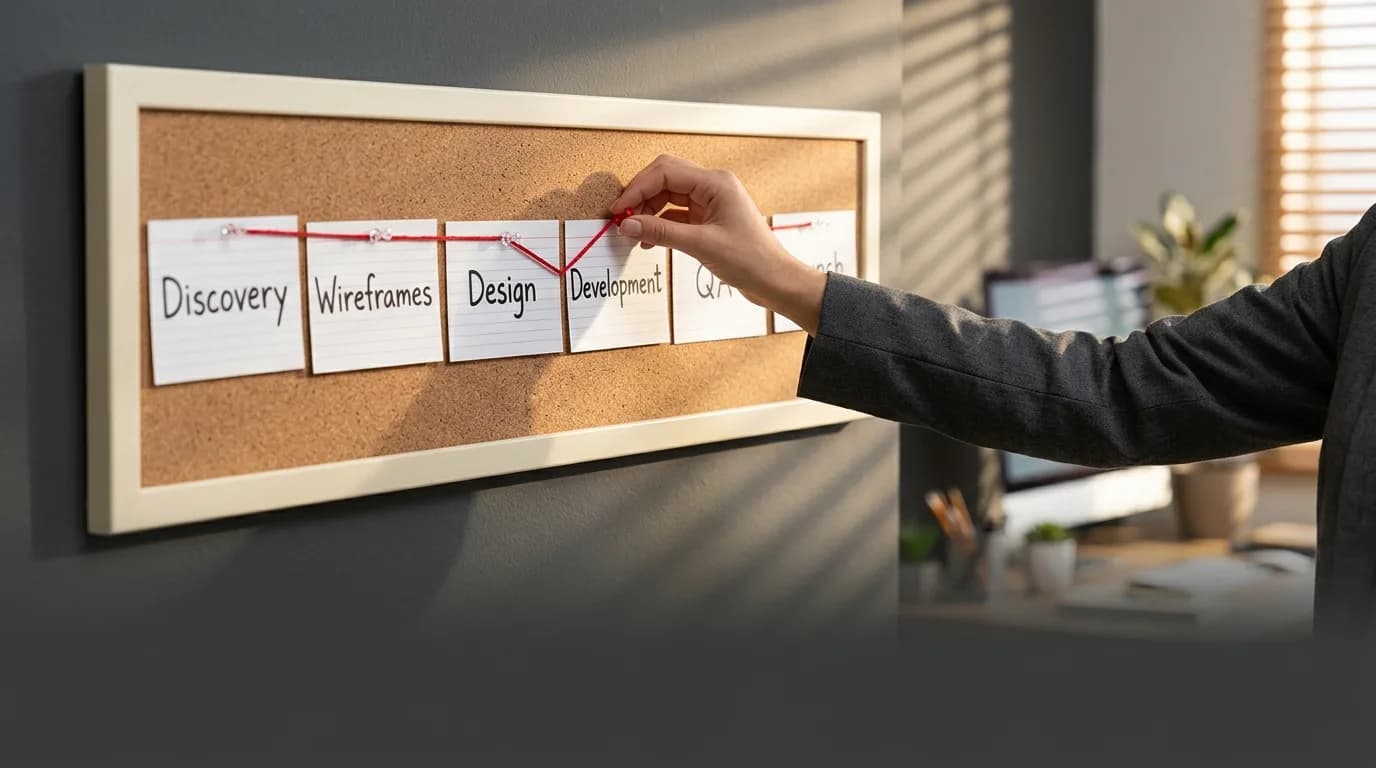
A website redesign moves through six phases: discovery, information architecture, visual design, development, content and QA, then launch. Industry-wide, that runs 8 to 16 weeks for a typical small-to-mid-sized site. HubSpot's survey of over 6,000 customers puts the traditional redesign at 3 to 4 months, in the same range. Clutch's own client-review data puts the average web design project at 7 months start to finish, longer still, since that figure covers every project it tracks rather than a redesign specifically. Our own version of that same six-phase timeline is published tier by tier, not left as a guess.
The Six Phases of a Website Redesign Timeline
Every credible framework for this breaks down roughly the same way, whether an agency calls it four stages or eight. Here is the version most sites actually follow:
| Phase | Typical duration | What it produces |
|---|---|---|
| Discovery & strategy | 1 to 3 weeks | Goals, scope, sitemap |
| Information architecture & wireframes | 1 to 2 weeks | Page structure, navigation |
| Visual design | 2 to 4 weeks | Approved look and feel |
| Development | 2 to 8 weeks | A working, coded site |
| Content, QA & testing | 1 to 2 weeks | Real copy in place, bugs caught |
| Launch & post-launch | Ongoing | Live site, monitoring |
Our Own Process, Mapped to Those Phases
We collapse the six phases above into four steps, and we publish what happens in each one rather than leaving it generic:
- Free Consultation. 30-minute call to discuss your goals and requirements.
- Proposal & Agreement. Detailed proposal with timeline, deliverables, and fixed pricing.
- Design & Development. We build your site with regular updates and 2 revision rounds.
- Launch & Support. Go live with 30 days of hands-on technical support.
Step three is where discovery's output becomes a real, coded site, and it is also where our revision rounds live: one round on Starter, two on Professional, unlimited on Enterprise. The published delivery windows are 2-week delivery for a five-page site, 3 to 4 week delivery for ten pages, and 4 to 8 week delivery for fifteen or more.
Discovery: What Actually Happens Here
Discovery is information-gathering, not design work yet. A proper discovery phase talks to whoever actually runs the business, not just whoever signs the contract. It maps what the current site is missing, and it defines what the new one needs to do before a single mockup gets drawn. Skipping or rushing this step is the single most common reason a later phase gets reopened. A requirement nobody asked about at the start tends to surface during development instead, once changing it costs real time.
Design Phase vs. Development Phase: Which Takes Longer?
Development typically runs longer than design. Visual design usually takes 2 to 4 weeks. Development, the actual coding and feature build, usually runs 2 to 8 weeks depending on complexity. Design feels slower to a client because every round needs sign-off. Development feels faster because most of it happens without the client watching, even though it is doing more total work over the course of the project.
Content, QA and Launch
Content and QA is where timelines quietly slip. It depends on copy and images the client has to supply, not on the agency's calendar. Plan a day or two of testing for every week of development, more if the site has booking, payment or membership features. Launch itself is fast, usually a single afternoon once everything upstream is approved. What follows it is the part agencies most often skip: watching for broken links, confirming analytics is actually tracking, and fixing whatever QA missed once real visitors start using the site instead of a test account.
Can Phases Overlap to Save Time?
Some can. Wireframes can start before discovery's final sign-off if the scope is already clear. Content writing can run alongside visual design instead of waiting for development to finish. What cannot overlap safely: development starting before wireframes are approved, because building against a structure that then changes means rebuilding, not adjusting.
A Real Project Mapped to This Timeline
Carter Hearing's full redesign, four clinics and two mobile hearing-aid units, took 4 weeks start to finish. Image optimization alone took the homepage from 4.2 MB to 840 KB. That work happened in content and QA, not development, and it is what dropped mobile Largest Contentful Paint from 6.8 seconds to 2.4 seconds before launch, well inside Google's 2.5 second "good" threshold.
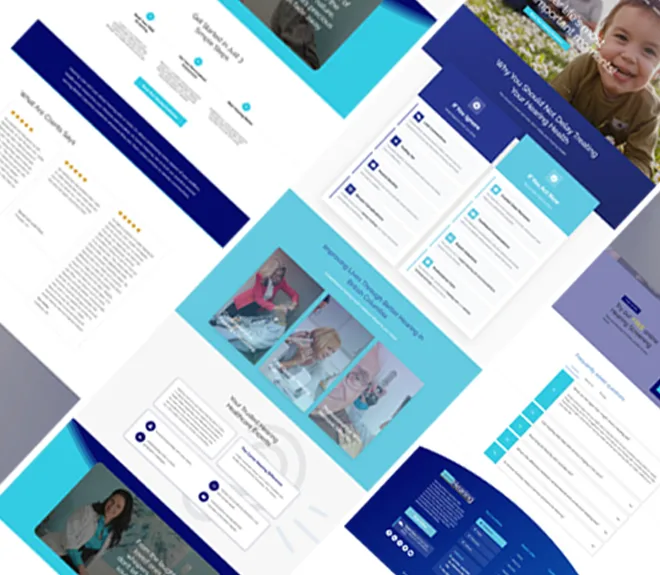
Carter Skin, a med spa with two clinic locations, ran 5 weeks on Wix. Both projects moved through the same six phases above. Neither one skipped a step to hit its deadline.
Waterfall or Agile: Which Approach Are You Actually Using?
Most of what is written about the six phases assumes waterfall: one phase finishes and gets signed off before the next one starts. That is what we run, and it is a deliberate choice, not a default. A fixed price only works against a fixed scope, and a fixed scope only holds if design is not still changing once development has started. Agile website work runs in 1 to 2 week sprints instead, shipping a usable increment each time and adjusting as it goes, which suits an ongoing product more than a one-time redesign with a fixed budget. Most teams that claim to run agile on a redesign are actually running a hybrid: waterfall's fixed phases with sprint-style check-ins inside each one. Know which one you are actually running before you promise a launch date, because the two produce genuinely different timelines from the same six phases.
Keeping Your Timeline Real, Not Optimistic
Ask any agency quoting a redesign to name which of the six phases their number covers. A quote that only counts development time will look faster than one that counts discovery through launch. The second one is the honest number, even though it reads as the bigger figure on paper. Full pricing tied to each of our own delivery windows is in the website redesign cost breakdown, and what actually stretches a timeline past its estimate is covered separately if content or feedback delays are the bigger risk for your project. For a checklist built on these same six phases, see the complete website redesign checklist.