
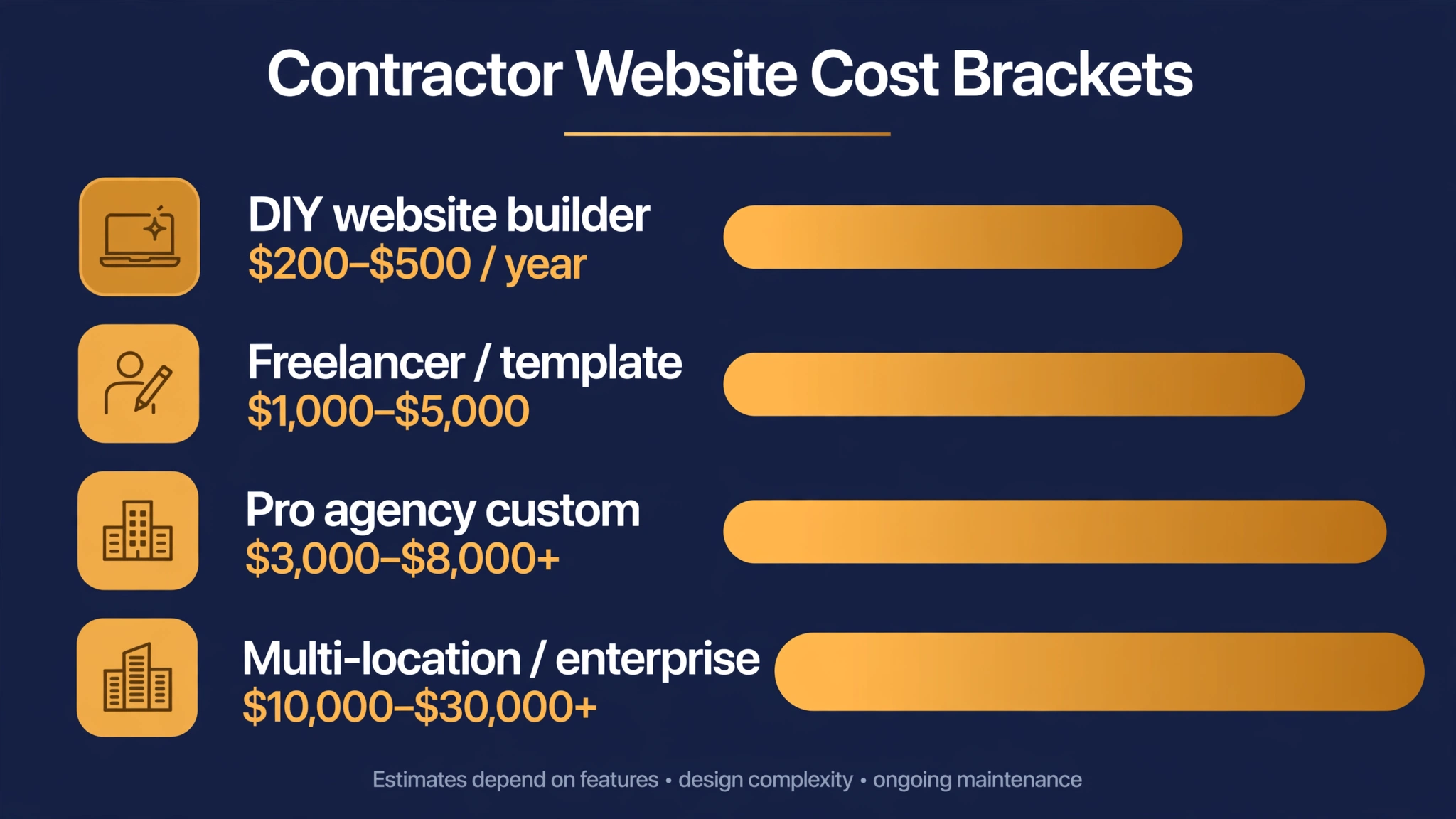
A contractor website costs $200 a year if you build it yourself on a site builder, $1,000 to $5,000 from a freelancer working off a template, $3,000 to $8,000+ from an agency building it custom, and $10,000 to $30,000+ for multi-location or enterprise work. Those brackets come from a 2026 construction pricing guide that pulled together agency surveys and contractor sources, and they match what we see quoted week after week. Our own prices are fixed and published: $799 for a starter site, $1,499 for a full custom build, and $2,499+ and up for larger work. You can check them on our pricing page right now.
Quotes vary so much because contractors are not buying the same product. A five-page brochure site and a fifteen-page lead machine with town pages, booking software and local SEO are different projects that happen to share the word website. This guide shows the brackets, the five decisions that move you between them, the monthly costs nobody puts in the quote, and the red flags we tell people to watch for even when they hire someone else.
The Four Brackets, Honestly Described
Every contractor website quote falls into one of four brackets. The bracket matters more than the vendor, because a $1,500 freelancer and a $1,500 agency are selling different things at the same price.
DIY site builder: $200 to $500 a year
Wix, Squarespace or WordPress.com money. You get hosting, a template and a drag-and-drop editor for one annual fee. This works for a solo operator who needs to exist online and has more time than budget. It stops working when the site needs to rank: templates built for everyone are optimized for no one, and most builders make real local SEO (a page per service, a page per town, schema markup, speed control) difficult or impossible. Fine as a placeholder. A bad home for a growing company.
Freelancer or template build: $1,000 to $5,000
A freelancer installs a premium theme, customizes the colors and logo, loads in your copy, and hands over the keys. For a straightforward five-page site this is often the best value in the market. The risk is variance: freelancers range from excellent to unreachable by February, and a theme-based site inherits the theme's speed and SEO limits. Ask who handles updates after launch, because the honest answer is usually you.
Professional agency custom build: $3,000 to $8,000+
This is where the site is designed around your services and towns instead of fitted into a theme: custom design, a page per service, town pages, tap-to-call, quote forms, reviews wired in, schema markup, speed work and analytics. GoodFirms' 2026 agency survey (summarized in Qrolic's construction pricing guide) found fixed-price web projects ranging from about $1,000 past $150,000, with 63% landing between $1,000 and $15,000, which puts most contractor custom builds in the lower half of that band. You are paying for the thinking (which pages, which towns, which calls to action) as much as the building.
Multi-location or enterprise: $10,000 to $30,000+
Several branches, dozens of service-area pages, CRM and dispatch integrations, custom estimating tools, professional photography. At this level the website is business software with a marketing front. One honest test: if a quote at this level describes a five-page template with your logo on it, the price is not the problem. The scope is.
Five Decisions That Move the Price
Not the feature list. When we quote, these five structural decisions move the number more than everything else combined. Answer them before you ask anyone for a price and the quotes that come back suddenly become comparable. Skip them and you will be handed four numbers that describe four different projects.
1. How many pages does the site actually need?
A homepage, a contact page and an about page are the floor. Every service that should rank on its own is a page that needs writing: roof replacement and roof repair are different searches, and one page listing both ranks properly for neither. Writing is the slow, expensive part of a build, so page count is the first thing that moves a quote.
2. How many towns do you actually serve?
A town page only earns its keep if it says something true about that town: the housing stock, the common jobs, a local review. Ten genuinely different town pages are ten small writing projects. Ten pages with the town name swapped are doorway pages, which Google treats as spam. Get the per-page price in writing, and ask what makes each town page different from the others.
3. Does the site need to book jobs, or just take calls?
A tap-to-call button costs nothing to add. Online scheduling that writes into your dispatch or CRM system is an integration, and integrations are where quotes separate hardest. Most plumbing and HVAC work still gets booked by phone, so booking software is worth paying for only when your jobs are scheduled rather than urgent. Be clear which one you need before you compare numbers.
4. Who is writing the copy?
If you supply the words, the build is cheaper and usually better, because you know what customers actually ask on the phone. If the agency writes it, that is real hours: interviews, drafts, revisions. Quotes that look unusually low often assume you are supplying everything, so check that line before you call one number cheaper than another.
5. How deep does the SEO go?
Basic on-page SEO (titles, headings, meta descriptions, image alt text) is table stakes and should be inside any professional quote. The expensive version is local SEO architecture: Google Business Profile setup, service-area pages, LocalBusiness schema, citation cleanup, review wiring. That is a separate workstream with its own price, and it is the part that actually brings calls. Our local SEO checklist walks through what it covers.
The Monthly Cost Nobody Puts in the Quote
A website is not a one-time purchase even when the build is. Hosting, security updates, backups, uptime monitoring and small content changes run $30 to $300 a month depending on who handles them, and contractor pricing guides land in that band consistently. Then there is the question of who fixes things when something breaks at 9pm before a Monday full of estimates.
Our answer is care plans from $99 to $399 a month: updates, backups, security monitoring and uptime checks, with the larger plans adding change hours and same-day response. Published like everything else, no lock-in. Whatever you choose, budget the monthly line separately from the build, because the cheapest build with nobody maintaining it is how a three-year-old site ends up with a footer that says 2021.
Red Flags in a Quote
We tell people to walk away, or at least ask hard questions, when a quote has any of these:
- Hourly billing with no cap. A $2,000 site billed hourly becomes a $5,000 site the moment the project drifts. Fixed price, agreed in writing, before work starts.
- A monthly lease on a site you will never own. Some builders charge $99 to $300 a month forever and the site vanishes if you stop paying. You should own the site, the domain and the content from launch day.
- No ownership clause. If the contract does not say you own the site, assume you do not.
- "SEO included" with no deliverables list. SEO is not a line item, it is a list: which pages, which schema, which profiles, which reports. Ask for the list.
- A five-figure price for a five-page template. At $10,000+ you should be getting strategy, custom design, copywriting and integrations. If the deliverable is a theme with your logo, the scope does not match the price.
Our Contractor Website Prices
Published in full, because secret pricing wastes everyone's time:
- $799 Website Starter: template-based custom design, up to 5 responsive pages, mobile-friendly, basic on-page SEO, contact form and Google Maps. Two-week delivery.
- $1,499 Website Professional: fully custom design, up to 10 responsive pages, advanced SEO plus schema markup, speed optimization, Google Analytics and Search Console, blog setup. Three to four week delivery.
- $2,499+ Website Enterprise: custom architecture from scratch, 15+ pages, service-area pages, booking systems and integrations for established contractors.
Half to start, half at launch. No hourly billing, no yearly contract. The full breakdown with care plans is on our pricing page. If you are comparing against a redesign rather than a fresh build, our website redesign cost guide covers that side, and the plumbing website cost breakdown goes deeper on one trade.
What To Do Next
If you already have a site, start with our free website review: send the URL and we run it through the same checks we use on our own builds (speed on a phone, tap-to-call, local SEO basics, schema) and send back what to fix first. No charge, and no call needed. If you are starting from zero, the pricing page has the exact numbers and the free quote form takes about two minutes.