
Local SEO for contractors is the work that puts your business in front of homeowners searching for your trade in the towns you cover: the three map results, the organic results under them, and increasingly the AI answer above both. For a roofer, plumber or general contractor it comes down to seven things. A Google Business Profile set up as a service-area business, the same name and phone number everywhere, a page for every service and town, the schema type for your trade, a site that works on a phone, a steady flow of reviews, and listings in the directories contractors actually use.
None of it is complicated, and most of it costs nothing but time. The reason it still matters is that most contractors skip it. We measured 360 contractor websites in August and September 2026, and the gaps below showed up again and again. This is the local SEO checklist we work through for every contractor site we build, in priority order.
What local SEO for contractors actually means
Google is unusually open about how local results work. Its own help page says local results are mainly based on relevance, distance and prominence. Relevance is how well your profile matches the search. Distance is how far you are from the person searching. Prominence is how well known your business is, and Google says it draws partly on how many websites link to you and how many reviews you have. The same page states plainly that there is no way to pay for a better local ranking.
People look for this help in different words. Some search for local SEO services for contractors, some for SEO for local contractors, and plenty simply type local SEO contractors. It is the same work in every case, and this checklist covers all of it whether you do it yourself or hire it out.
That gives contractors a clear job. You cannot move your office closer to every customer, so the work goes into relevance and prominence: a profile and website that describe exactly what you do and where, and the reviews and mentions that prove you are real. Regular SEO tries to rank a page anywhere in the country. Local SEO tries to win a search from someone ten miles away who needs a roof inspection this week, which is a smaller, more winnable fight.
1. Set up your Google Business Profile as a service-area business
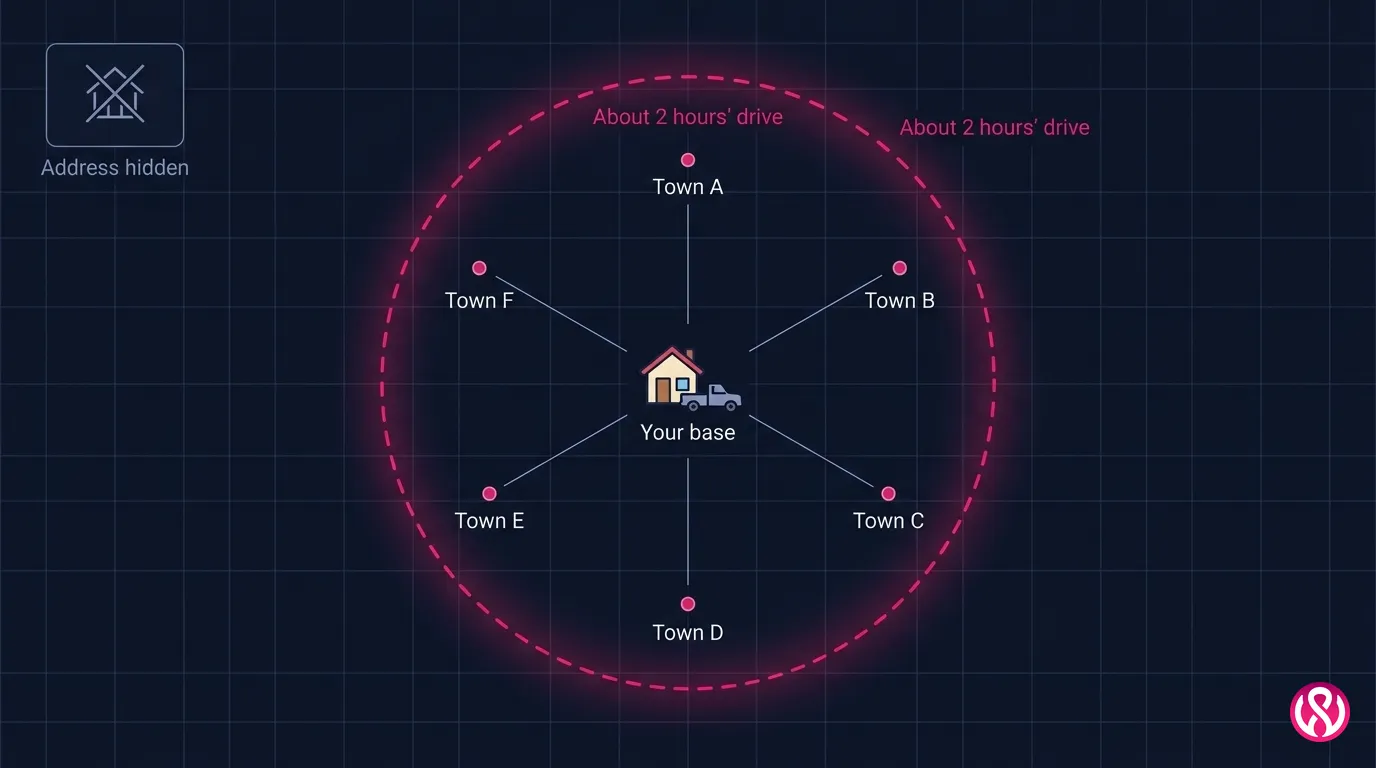
Most contractors work at the customer’s address, not their own, and Google has a setup built for exactly that. Google’s service area guidelines say that if you do not serve customers at your business address, you should remove the address from your profile. You can list up to 20 service areas, and the whole area should stay within about two hours’ driving time of where you are based. Get this wrong, for example by listing a home address customers cannot visit, and you risk the profile being suspended.
Then choose your primary category with care. In Whitespark’s 2026 Local Search Ranking Factors report, the number one factor for the map pack is the primary Google Business Profile category. Pick the most specific one that matches the work you want most: Roofing contractor, Plumber or General contractor, not a vague Contractor. Add secondary categories for the other work you do.
A Google Business Profile for contractors also needs everything else filled in: every service with a short description, hours, a phone number that rings a person, and real photos of your crew, trucks and finished jobs. Add new photos after big jobs, and use the Q&A section to answer what customers ask on the phone: whether estimates are free, which towns you cover, and whether you work with insurance claims.
2. Keep your name, address and phone identical everywhere
NAP means name, address and phone number, and it needs to match exactly wherever your business appears: your website footer, your Google profile, Facebook, Angi, the Better Business Bureau and every other listing. “Smith Roofing LLC” in one place and “Smith Roofing & Exteriors” in another looks trivial to a person and like two different businesses to a search engine.
Contractors often fall into this trap, because old listings pile up over the years. A number from a previous office, a trade name you stopped using, a listing a sales rep created years ago. Search your business name in quotes, then search your phone number, and work through the first three pages of results. Fix or remove every mismatch you find. If you are a service-area business with a hidden address, keep the address off your website as well, so the two sources agree.
This is the least exciting item on the list and one of the most useful. Consistent details are how Google confirms that the business on the map, the business on the website and the business in the directories are the same company, which feeds straight into prominence.
3. Build a page for every service and every town you cover
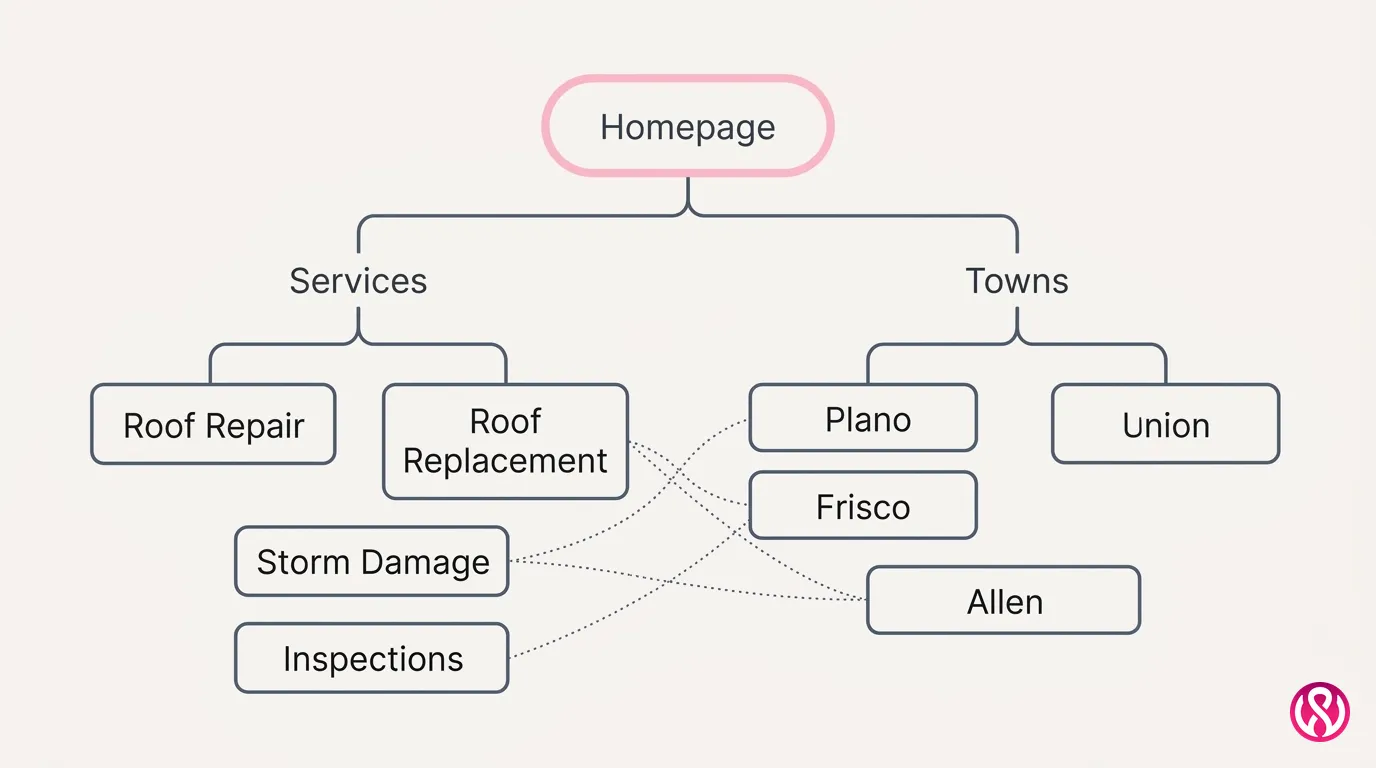
One page that lists “roofing, siding, gutters and storm damage in Dallas, Plano and Frisco” can rank properly for none of those searches. Each main service needs its own page, and each town you genuinely serve needs its own page, written about the work you do there. That structure is what lets a site show up when someone searches for “roof repair Plano” rather than only for your company name.
There is one rule you cannot bend: every town page must be genuinely different. Google treats near-identical pages with the city name swapped as doorway pages and ignores them. The test is simple. Delete the town name from the page. If you can no longer tell which town it is about, it is not ready. Real content means jobs you have done there, the housing stock and weather you deal with, permit quirks, and how quickly you can get a crew out.
Start with the three towns that bring you the most profitable work, not all twenty. Three strong pages beat twenty thin ones, and you can add more once the first few start pulling in calls. Link each service page to the town pages where you do that work, and back again.
4. Add the schema type built for your trade
Schema is code that tells search engines what your business is, where it works and when it is open. Visitors never see it. Schema.org publishes specific types for contractors: RoofingContractor, Plumber and GeneralContractor all sit under LocalBusiness, so they carry your service area, hours and contact details. Use the type that matches your trade rather than a generic one, and skip ProfessionalService, which Schema.org has deprecated.
At minimum include your business name, phone number, website address, areaServed with the towns you cover, and openingHours. Test it with Google’s Rich Results Test before you publish, and fix every error it reports.
This is the cheapest ranking signal on the list, and it is widely missing. Of the 342 roofing company websites we measured on 13 September 2026, 51 carried no structured data at all. Four of the eight plumbing websites we measured on 6 August had no LocalBusiness markup, and none of the ten construction sites we measured on 12 August used the GeneralContractor type.
5. Make the site fast and easy to call from a phone
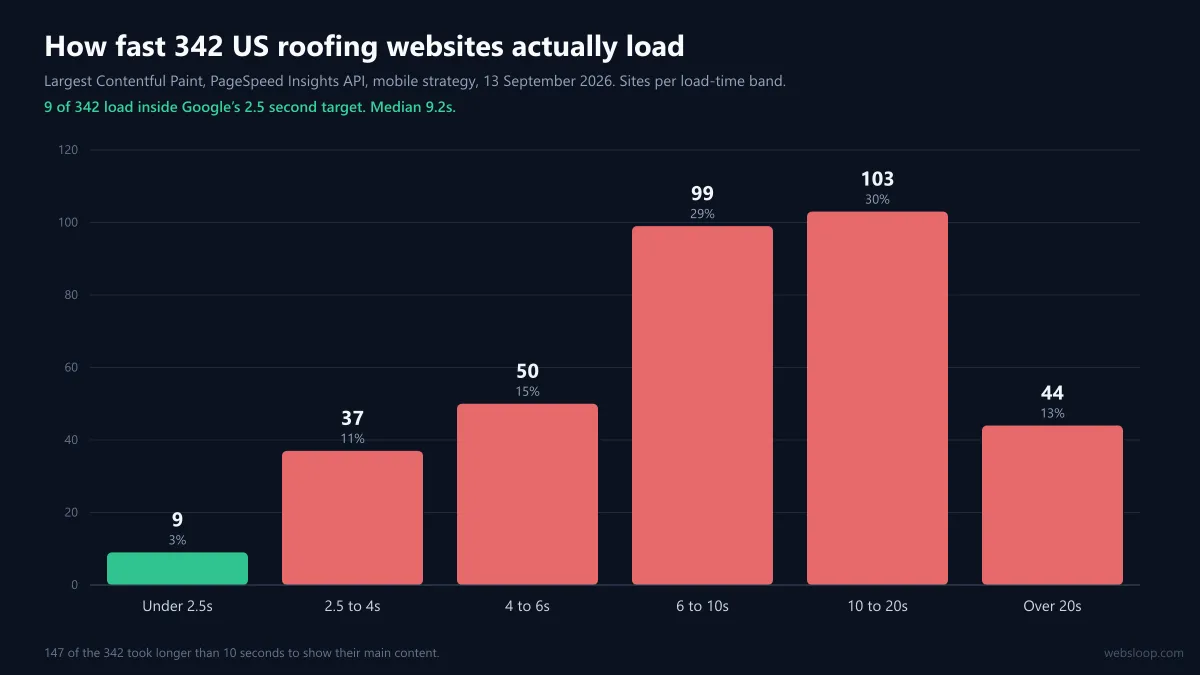
Local searches happen on phones, often straight after a leak or a storm, and the visitor decides within seconds whether to call you or go back to the results. Google’s target is to show the main content within 2.5 seconds. In our roofing study, only 9 of 342 sites managed it. The median site took 9.2 seconds, and 147 took longer than ten seconds before a visitor saw anything useful.
Speed is only half of it. 77 of those roofing homepages had no tap-to-call link, so a phone visitor could not dial with one tap, and 144 had no form for requesting a quote or an inspection. Put a call button that stays in reach on every page, a short form that asks only what you need to price the job, and your service areas where a visitor can see them without scrolling.
If your site is slow, fix it before spending money anywhere else. A faster site does not rank by itself, but a slow one wastes every visitor the rest of this checklist brings in. Our roofing website design page publishes the full study, and the best roofing websites shows what the fastest ones do differently.
6. Earn a review after every job, and answer all of them
Reviews are both a ranking signal and the thing homeowners read before they call. BrightLocal’s 2026 Local Consumer Review Survey found that 97% of consumers read reviews for local businesses, and 74% look for reviews written in the last three months. A pile of old five-star reviews followed by a year of silence reads as a business that may have slowed down.
Make the ask part of how every job ends. The best moment is when the customer is looking at the finished work: a new roof, a fixed leak, a completed kitchen. Send the direct review link by text that day, not in an email a month later. Ask what they would tell a neighbor, which tends to produce reviews that mention the service and the town, and those details help relevance.
Reply to every review, good and bad. The same survey found 81% of consumers expect a response within a week. A calm, specific reply to a complaint often does more for a nervous homeowner than another five-star rating, because it shows what happens when something goes wrong. Never buy reviews, write them yourself, or offer a discount in exchange for one. Google’s review policy bans all three, removes the reviews, and can suspend the accounts involved.
7. Get listed where contractors are listed
Citations are mentions of your business details on other websites. For contractors, the ones that matter are the platforms homeowners already use: Angi, HomeAdvisor, Houzz, Thumbtack, Nextdoor, Yelp and the Better Business Bureau. Add your state contractor license lookup, your local chamber of commerce, and any manufacturer or supplier directories you qualify for, such as a shingle manufacturer’s list of approved installers.
Accuracy beats volume here. A dozen accurate listings on sites your customers actually visit do more than hundreds of directory submissions from a cheap citation service, which usually creates the NAP mismatches you worked to remove in step two. Links from genuinely local sources, such as a supplier featuring your work or a community group you sponsor, count as well, because Google names links as part of prominence.
Local SEO for roofers, plumbers and general contractors: what changes by trade
The checklist is the same for every trade. What changes in local SEO for contractors is where the effort goes.
Local SEO for roofing companies leans on storm demand and trust. Build a storm damage page, explain how you handle insurance claims, and show before and after photos of real roofs. Any manufacturer programs you belong to and your license number belong on the page, not only on a wall in the office. Roofing searches spike after bad weather, so a fast site and an inspection request form matter even more. Local SEO for roofers who work alone follows the same order on a smaller patch.
Plumbers win on urgency. An emergency page with the phone number in the first screen, accurate out-of-hours times in your Google profile, and separate pages for drain, water heater and repiping work. See our plumbing website design page for how that structure looks in practice.
Local SEO for general contractors depends on proof. Homeowners planning a remodel research for weeks, so a project gallery with the scope, town and timeline of each job does more work than any ranking tactic. Split residential and commercial into separate pages, because they are different searches with different buyers. Our construction website design page covers the details.
How to tell whether your local SEO is working
Three numbers are enough to judge local SEO for contractors. First, the performance report inside your Google Business Profile: calls, direction requests and website clicks, month over month. Second, Google Search Console impressions for searches that include your town names, which shows whether your service and town pages are gaining ground. Third, the one most contractors never track: ask every new customer how they found you, and write the answer down.
Check monthly, not daily. Local rankings move around from day to day and from street to street, so a single search from your office tells you very little. The trend over two or three months is what counts, and calls are the number that pays the bills.
The mistakes that undo the work
A few habits wipe out months of work on local SEO for contractors. Stuffing town names into every sentence reads as spam to Google and to homeowners. Buying bulk citation packages creates hundreds of inconsistent listings that take months to clean up. Fake reviews, from the owner, staff or a paid service, put the whole profile at risk. And adding keywords or towns to your business name on Google breaks Google’s guidelines for representing your business, which say unnecessary information in the name can get the profile suspended.
The quieter mistake is doing everything once and never touching it again. Profiles need new photos, reviews need replies, and town pages need updating when you add services or areas. An hour a month keeps it working. Zero hours lets a more active competitor pass you one review at a time.
A 30-day local SEO checklist for contractors
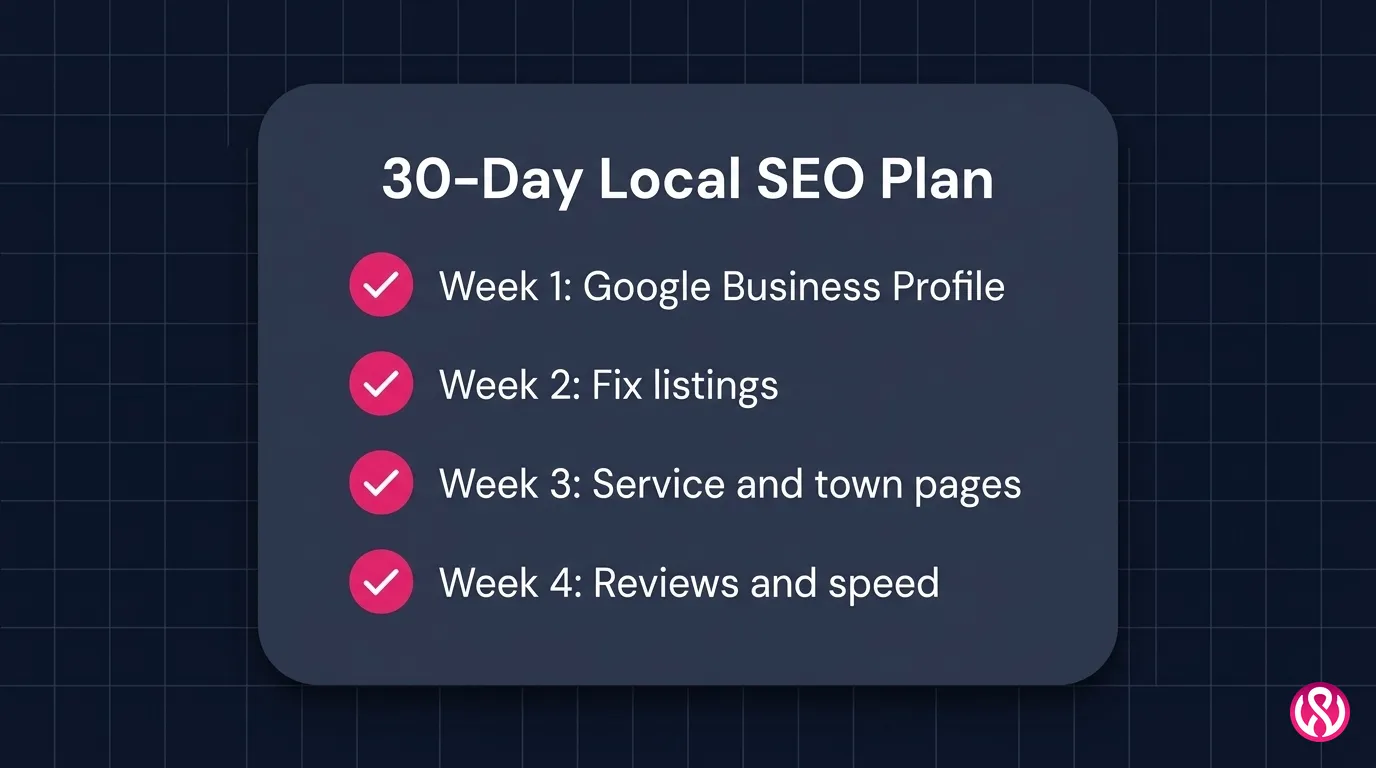
If you only have a month, work through it in this order:
- Start with the profile (week 1): set up or fix your Google Business Profile as a service-area business, choose the most specific primary category, list every service, and add 10 real job photos.
- Then clean up your listings (week 2): search your business name and phone number, fix every mismatched listing, and claim your profiles on Angi, Houzz, the BBB and Nextdoor.
- Build your first pages (week 3): build one strong service page and one strong town page for the work you want most, with the schema type for your trade.
- Finish with reviews and speed (week 4): text a review link to your last ten happy customers, reply to every existing review, and check your site speed in Google PageSpeed Insights.
That month puts you ahead of most contractors in your area, because most of them do none of it. Keep going from there: a new town page each month, a review request after every job, and a profile update after every big project.
What a website build covers, and what it does not
Half of contractor local SEO lives on your website and half lives off it. The website half is the structure, the service and town pages, the schema, the speed and the tap-to-call button. We build all of that into every site as part of our contractor website design work, starting at $799. The off-site half is your Google profile, reviews and listings, which need a steady hour or two a month from you or someone you pay to do it.
If you want to know what ongoing help would cost, our guide to how much SEO costs sets out real prices, and roofers will find the trade-specific version in our guide to local SEO for roofing companies. Our contractor SEO services page shows what a fixed-price project covers for roofers, plumbers and builders, with roofing SEO in more detail. If your current site is the problem, start with the checklist above and a speed test. It will tell you quickly whether a fix or a rebuild makes more sense.