Of the 8 plumbing websites I measured, Nautilus Plumbing came out fastest and was the only one to load its main content inside Google’s 2.5 second target, at 2.4 seconds from a 578 KB page. Even it failed on layout stability. The heaviest site shipped 27.7 MB and the slowest took 17.4 seconds on mobile.
Every other list of plumbing websites tells you which ones look good. Looks are not why a plumbing site does or does not ring the phone. So I ran 8 of them through Google’s own tools on 6 August 2026 and wrote down what came back. If you are researching web design for plumbers, this is the data most of those pitches skip.
How I Measured These Plumbing Websites
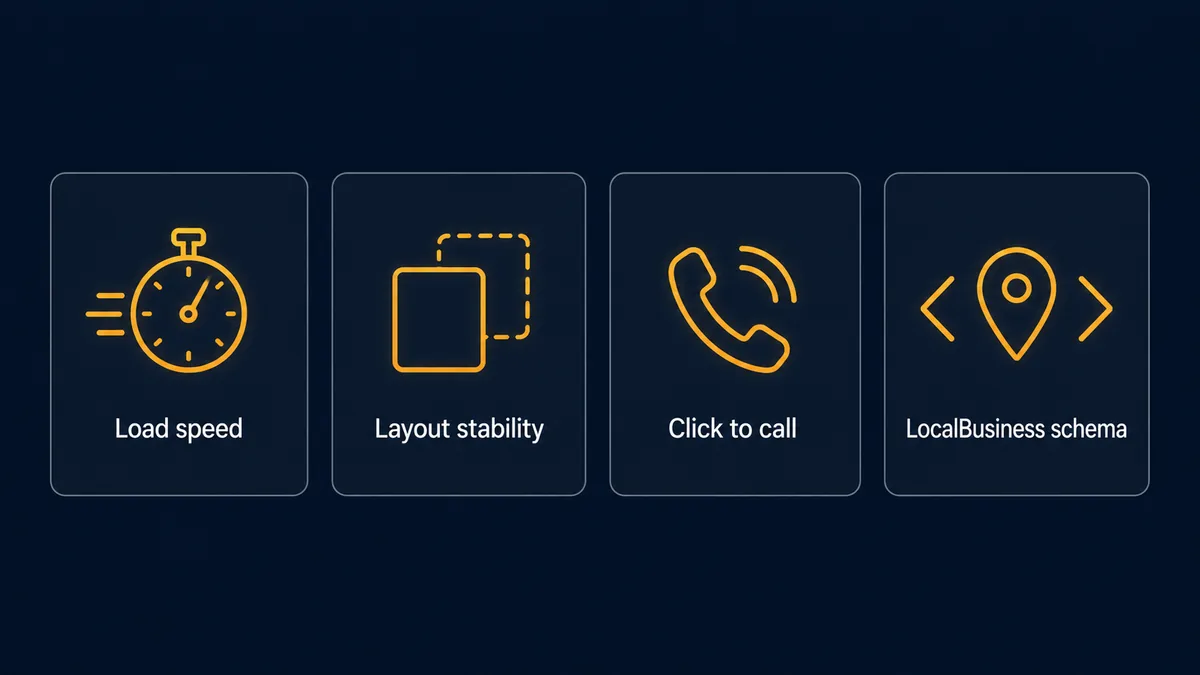
Every homepage went through Google's PageSpeed Insights API on the mobile setting. Per Google's own PageSpeed Insights documentation, a lab score of 90 or above counts as good, 50 to 89 needs improvement, and below 50 is poor. That returns the performance score, Largest Contentful Paint (how long until the main content appears), Cumulative Layout Shift (how much the page moves while it loads), and total transfer weight. I then fetched each homepage directly to count click-to-call links and read its structured data. These are lab numbers from one day, not permanent grades.
Why speed matters more in this trade than most
Plumbing searches are urgent in a way most searches are not. Somebody watching a leak spread across a ceiling is not going to wait seventeen seconds for a homepage to appear, and the back button is one tap away. Speed here is not a technical nicety. It is whether the phone rings.
The Results: 8 Plumbing Websites, Side by Side
Sorted by performance score. Roto-Rooter’s US site is deliberately absent: PageSpeed returned a 1 KB document for it, which is a bot block or a redirect rather than the real page, so no score for it would be honest. I would rather leave a famous name off the list than publish a number I cannot stand behind.
| Website | Score | Load (LCP) | Shift (CLS) | Page weight | Call links | Local schema |
|---|---|---|---|---|---|---|
| Nautilus Plumbing Los Angeles, USA | 81 | 2.4s | 0.2 | 578 KB | 9 | yes |
| Plumb London London, UK | 79 | 4.1s | 0.091 | 686 KB | 9 | no |
| Benjamin Franklin Plumbing National, USA | 74 | 4.4s | 0.011 | 1,598 KB | 5 | no |
| Ninja Plumber Los Angeles, USA | 65 | 10.9s | 0 | 1,912 KB | 4 | no |
| Roto-Rooter Canada Canada | 55 | 16.8s | 0.062 | 5,345 KB | 8 | no |
| Rooter Hero California and Arizona, USA | 46 | 17.4s | 0.003 | 27,659 KB | 10 | yes |
| Ritz Plumbing Los Angeles, USA | 45 | 4.8s | 0.004 | 2,721 KB | 6 | yes |
| The Pink Plumber Georgia and Tennessee, USA | 29 | 11.3s | 0.005 | 5,455 KB | 11 | yes |
The Four That Load Reasonably Well
Four sites scored 60 or better on mobile, and one of them cleared Google’s 2.5 second target. None is flawless, and the gaps are instructive because in two cases the missing piece costs nothing at all to add. Speed alone was never the whole job here. A fast page that hides its phone number still sends an anxious customer back to the results.
Nautilus Plumbing (81/100)
Fastest of the eight, and the only one that loads its main content inside Google’s 2.5 second target.
What works: A 578 KB page is a fraction of what everyone else ships, and it shows. Nine click-to-call links mean the phone number is never more than a thumb away, and the LocalBusiness markup tells Google exactly which city it serves.
What it costs them: Layout shift of 0.2 is double the failing line. Something above the fold moves after the page paints, which is the effect of a customer tapping a button and hitting the wrong one.
Plumb London (79/100)
Leanest HTML document of the eight at 21 KB, and second fastest overall.
What works: Proof that a plumbing site does not need to be heavy. The document itself is roughly one sixty-fifth the size of the largest site here, and it still carries nine ways to call.
What it costs them: No LocalBusiness markup at all. For a firm whose entire market is one city, that is the cheapest ranking signal on the list and it is missing.
Benjamin Franklin Plumbing (74/100)
Most stable page of the eight, and the national brand that comes closest to loading well.
What works: Layout shift of 0.011 is close to perfect. Nothing jumps while the page loads, which is rarer here than it should be.
What it costs them: 1.6 MB and a 4.4 second load. The brand promise is punctuality, and the site takes almost twice Google’s target to show its main content.
Ninja Plumber (65/100)
Zero layout shift, and a load time that undoes the benefit entirely.
What works: A cumulative layout shift of exactly zero. Nothing on the page moves once it starts painting.
What it costs them: Ten point nine seconds to main content. Stability does not help a visitor who has already left, and four call links is the second lowest count here.
The Four That Lose Customers on Load
These scored under 60. Two of them are among the best known names in the trade, which is the point worth taking from this whole exercise: budget does not buy a fast website, and page weight does not care how many vans you have on the road.
Roto-Rooter Canada (55/100)
A 5.3 MB page taking almost seventeen seconds to show its main content on mobile.
What works: Eight click-to-call links, and layout shift stays inside the passing band.
What it costs them: Nearly seventeen seconds. A burst pipe does not wait that long, and there is no LocalBusiness markup to help the branch pages rank in the meantime.
Rooter Hero (46/100)
Clearest example on this list of good SEO thinking buried under a 27 MB page.
What works: Twelve separate LocalBusiness entries, one per service area, and ten click-to-call links. Someone here understands local search properly.
What it costs them: Twenty-seven megabytes. That is roughly ten times the median web page, and it produces a 17.4 second load. All that careful local markup is pointing search engines at a page most phone users will never see finish.
Ritz Plumbing (45/100)
Good structural choices, held back by 2.7 MB of page weight.
What works: LocalBusiness markup present and layout shift near zero at 0.004.
What it costs them: A 45 performance score and a 4.8 second load. The structure is right and the delivery is not.
The Pink Plumber (29/100)
Strongest conversion intent of the eight, and the lowest performance score.
What works: Eleven click-to-call links, more than any other site here, plus LocalBusiness markup with coordinates. The intent to convert is obvious in every design decision.
What it costs them: A performance score of 29 and 11.3 seconds to main content, from a 1.39 MB HTML document before a single image loads. Eleven ways to call do not help if nobody is still on the page.
What the Numbers Kept Showing
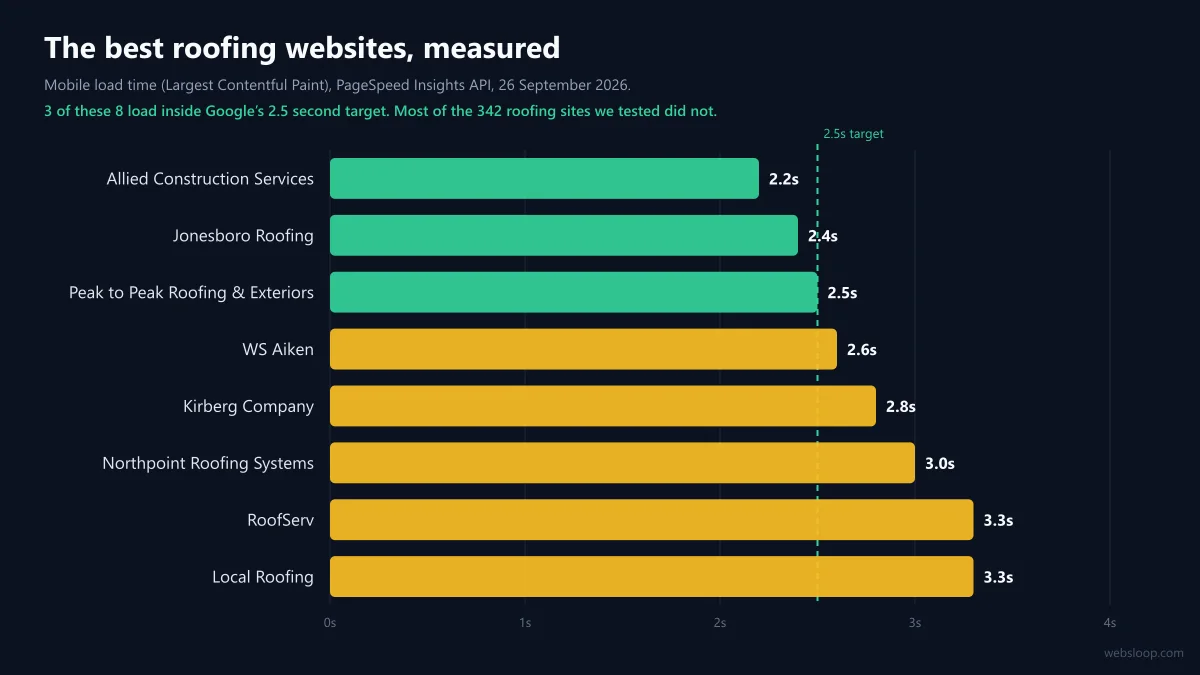
Plumbers are not the only trade with this problem. In a larger run of the same mobile test, on 342 US roofing contractor websites in September 2026, only 9 showed their main content inside Google's 2.5 second target. That study is on our roofing website design page, and the fastest of them are written up in the best roofing websites.
Page weight decided almost everything
The lightest sites were the fastest and the order barely changed between the two columns. Nothing else predicted speed as reliably. For context, the 2025 HTTP Archive Web Almanac puts the median mobile page at 2.56 MB. If you only fix one thing on a plumbing site, make the page smaller.
Good intentions are not delivery
The site carrying the most click-to-call links on the entire list, eleven of them, scored 29 and took 11.3 seconds to paint. Somebody there understood exactly what a plumbing site needs and then shipped it inside a page almost nobody waits for. Knowing the right answer and delivering it are separate problems.
Half of them skipped a free ranking signal
Four of the 8 had no LocalBusiness markup at all, including national brands. It is a small block of machine-readable code that tells search engines your business name, service area and coordinates. It costs nothing, takes minutes, and it is the easiest win on this entire list going unused.
How to Check Your Own Plumbing Website
Run your homepage through Google’s free PageSpeed Insights on the mobile setting and write down the score. Then open your site on your own phone and count how many taps it takes to reach the phone number. Those two checks take five minutes and will tell you more than any redesign pitch.
If you would rather I looked, I will run the same four checks on your site and send you the numbers with no obligation. We build plumbing and home service websites from $799, and the full price list is published, and speed is not an upgrade in any package. It is the starting point, and if your existing site just needs the speed fixed rather than a rebuild, see our SEO and speed optimization service instead. I ran the same checks on ten construction company websites too, where only two cleared the same target. If you have read enough measurements and want the build itself, everything we ship on a plumbing website design project is listed there with the price attached.