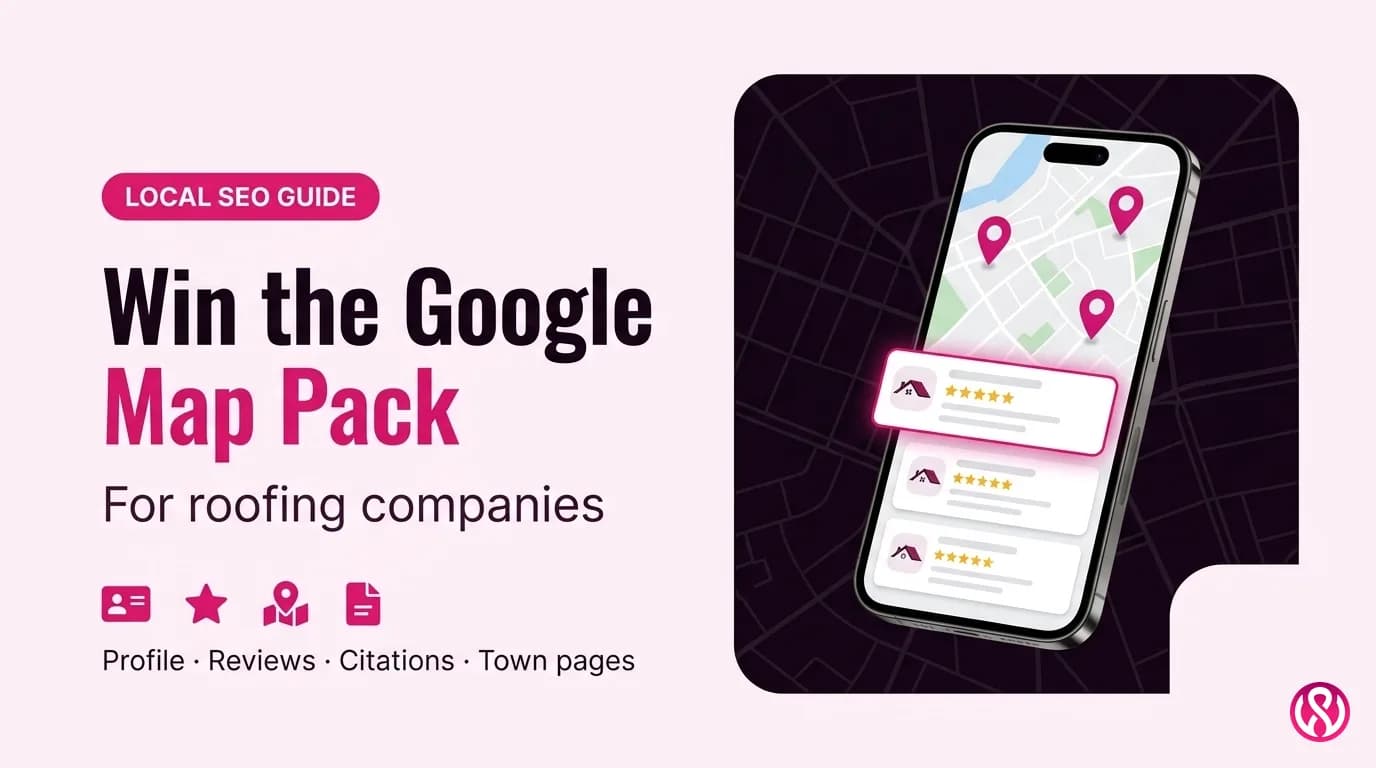
Local SEO for roofing companies is the work that decides whether you appear in the map results when a homeowner nearby searches for a roofer. Those three businesses shown with a map, often called the map pack or local pack, sit above the ordinary results on most roofing searches, and on a phone they can fill the whole first screen. Getting into them depends on four things you control: a complete Google Business Profile, a steady stream of recent reviews, business details that match across every listing, and a website with a page for each town you serve.
Owners phrase this in different ways: local SEO for roofers, local SEO for roofing company owners, local SEO services for roofing company websites, local SEO for roofing contractors, local SEO roofing companies ask agencies about, local SEO services for roofing companies, roofing company local SEO services, or roofing company local SEO marketing. It is all the same job, and it comes down to how SEO helps roofing companies win more local leads from the searches already happening in their towns. This guide is the map-pack half of roofing SEO in depth. For the whole picture, including service pages, speed and backlinks, start with our guide to SEO for roofers and come back here for the local detail.
We build and fix websites for US roofers, and before writing this we measured 342 roofing company homepages and read the eleven pages that currently rank for this search. Where this guide cites an outside rule or figure, the source is listed at the end of the page so you can check it.
What is local SEO for roofing companies?
It is the map-pack side of search engine optimization for roofers. Google says it ranks local results on three things. Relevance is how well your listing matches the search. Distance is how far you are from the person searching, or from the place they name. Prominence is how well known your business is, and Google says reviews and links feed into it. Local SEO is everything you do to improve relevance and prominence, because distance is fixed by where your business is.
That is why a roofer three miles away can outrank you in one neighbourhood and lose to you in the next. It also explains why the same few things keep coming up in every serious local SEO plan: the profile tells Google what you are, the reviews and listings tell it how established you are, and your website confirms both.
How is local SEO different from regular roofing SEO?
They answer different parts of the same search. Local SEO aims at the map pack, and it is driven mostly by your Google Business Profile, reviews and listings. Regular, or organic, SEO aims at the blue links under the map, and it is driven by your website: its pages, speed, structure and links.
| Local SEO (map pack) | Organic SEO (results below) | |
|---|---|---|
| Main lever | Google Business Profile | Your website pages |
| Proof Google reads | Reviews, listings, photos | Content, links, structure |
| Where you appear | Changes street by street | Much steadier across a city |
| Fastest wins | Category, services, service areas, reviews | Speed, titles, one page per service |
Roofers need both, because plenty of homeowners scroll past the map to the results beneath it, and because Google checks your website to decide whether your profile is telling the truth.
How do you set up a Google Business Profile for a roofing company?
Whitespark’s 2026 Local Search Ranking Factors report ranks the primary Business Profile category as the single strongest factor for the local pack. So start there, and treat the rest of the profile as the evidence behind that category.
- Primary category: “Roofing contractor” for almost every roofer. Add secondary categories only for work you really do, such as siding or gutters, and check the exact names in the category picker rather than guessing.
- Business name: your real name, exactly as it appears on your truck and invoices. Google’s guidelines do not allow extra keywords or towns in the name, and breaking that rule can get the profile suspended.
- Address or service area: if customers do not come to your office, hide the address and list service areas instead. Google allows up to 20, and asks that the whole area stay within about two hours’ drive of your base.
- Services: list every service separately, from repair and replacement to inspections, storm damage and gutters, each with a short plain description.
- Photos: your crews, your trucks, and finished roofs with the town in the file description, added as jobs finish rather than once a year.
- Hours and phone: the number a homeowner actually reaches, and emergency hours if you really answer at night.
- Website link: point it at your homepage, or at a town page if you run separate profiles for separate branches.
Two habits keep the profile working after setup. Post a short update when you finish a notable job or when storm season opens, and check the profile every month, because edits suggested by the public can change your details without you noticing.
Where should a roofing company be listed?
Every listing that shows your name, address and phone number is called a citation, and local citations for a roofer come from directories, maps apps and trade sites. They matter in two ways: search engines use them to confirm you are one real business, and homeowners find you on them directly. What matters most is that they agree with each other. An old phone number on one directory is worse than no listing at all, because it sends a caller to a dead line.
| Listing | Why it matters for a roofer |
|---|---|
| Google Business Profile | The map pack itself. Non-negotiable. |
| Apple Maps (Apple Business) | What iPhone users see in Apple Maps and Siri. Free to claim. |
| Bing Places for Business | Bing search and maps, which also feed Microsoft’s own assistant. |
| Yelp | Heavily visited for home services, and often ranks for “roofers near me” itself. |
| BBB | Many homeowners check it before letting a crew on the roof. |
| Angi and HomeAdvisor | Large home services directories. A free profile is not the same as paying for leads. |
| Houzz | Useful if you do higher-end residential work and have strong photos. |
| Nextdoor | Neighbourhood recommendations, which roofers win by word of mouth. |
| Facebook business page | Checked by homeowners, and a place to show recent jobs. |
| Manufacturer contractor locators | If you hold a shingle or metal roofing certification, the brand’s locator lists you. |
| Chamber of commerce and trade associations | Local, respected links as well as listings. |
Start with the first five, then work down the list. Before adding anything, search your business name and your old phone numbers to find listings you forgot about, and fix those first. Several data companies also pass business details between directories, so a wrong number in one place can spread; correcting the main listings usually stops it.
Apple Maps and Bing Places are the two most often forgotten. Neither was mentioned by any of the eleven pages ranking for this search, yet every iPhone owner who asks Siri for a roofer is reading Apple’s data, not Google’s. Both are free to claim and take about as long as a Google profile to set up, so do them in the same afternoon and copy your details across word for word.
How do reviews affect local rankings for roofers?
Reviews work on two audiences at once. Google counts them as part of prominence, and homeowners use them to choose between the three roofers in the map. BrightLocal’s 2026 Local Consumer Review Survey found 97% of consumers read reviews for local businesses and 74% look for ones from the last three months, so recency matters as much as the total.
The question roofers ask most here is simple: how do roofing contractors get more Google reviews? The honest answer is that they ask every time, make it one tap, and reply. Roofer reviews that mention the job and the town also read better to the next homeowner, which is why the roofing company reviews that rank well in the map rarely look like generic five-word praise. The roofing reviews examples worth copying describe what was done, how the crew behaved and how the site was left.
A review system that fits a roofing crew
- Send the review link by text the day the roof is finished, from the owner’s or foreman’s number if you can.
- Ask the homeowner to mention the service and their town, which gives the next reader and Google something specific.
- Reply to every review within a few days, and to negative ones calmly, with a way to reach you.
- Never pay, discount or reward anyone for a review. Google’s Maps content policy prohibits incentives, and removed reviews can take your rating with them.
A roofer who asks every customer, every time, will usually pass a competitor who has more reviews but stopped asking two years ago. The habit is the strategy, and it is how you get more roofing reviews without paying anyone for them.
Why does your map ranking change from street to street?
Because distance is one of Google’s three factors, the map pack a homeowner sees depends on where they are standing. Search “roofer near me” from your own office and you may be first. Drive fifteen minutes across town and search again, and you may not appear at all. Checking your ranking from one spot tells you almost nothing about the area you serve.
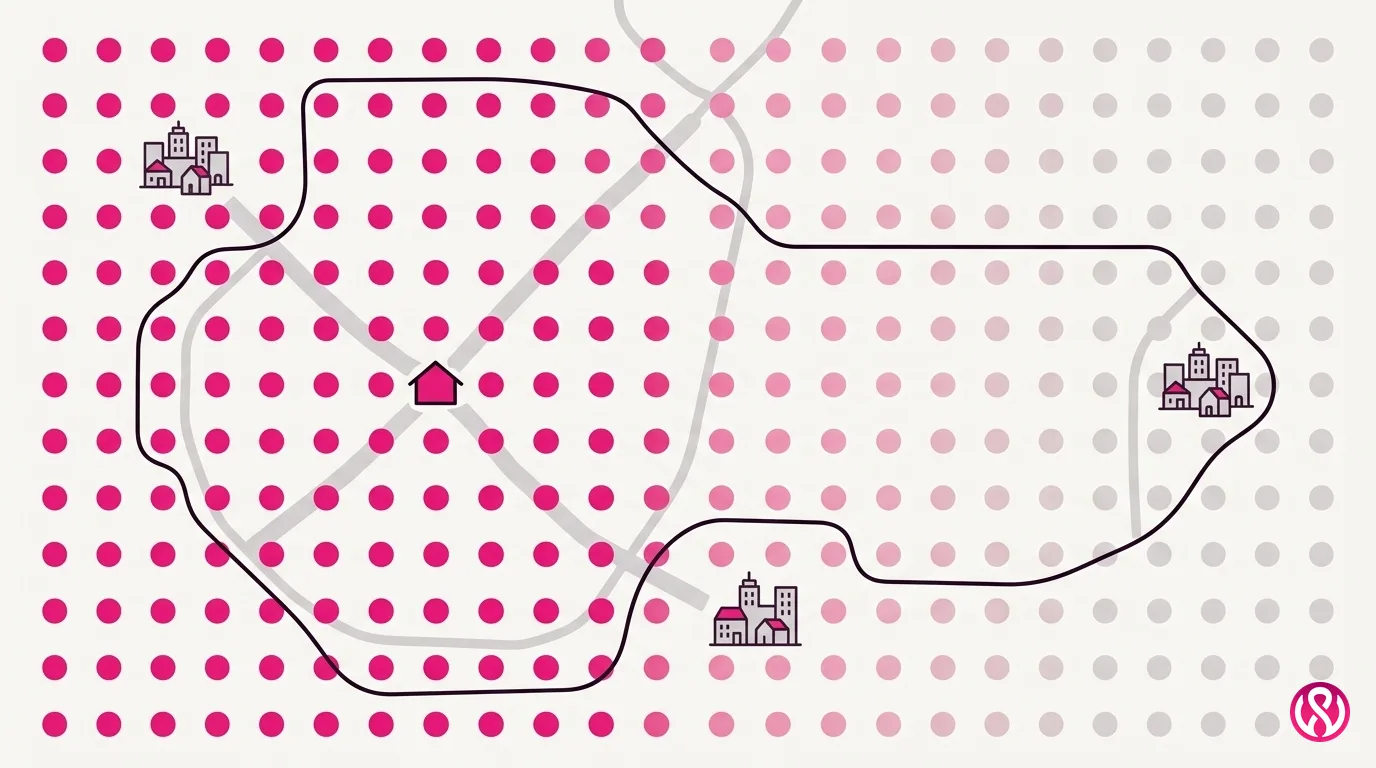
Map-grid rank tracking tools solve this by checking your position from a grid of points across your service area and showing it as a coloured map. The pattern tells you where to work: strong near your base and weak in a town you want work from usually means that town needs its own page on your site, reviews from customers there, and photos of jobs you did there. It also sets honest expectations, because no amount of work puts a roofer first in the map for a town forty miles away.
How can a roofer rank in towns without an office there?
Most roofers work across many towns from one yard, and Google’s service-area setting exists for exactly that. List the towns you genuinely cover, up to 20, on your profile. Then give each town that sends you real work its own page on your website, written about the jobs you do there. That pairing, a profile that says you serve the town and a page that proves it, is how a roofer earns visibility beyond the neighbourhood around the office.
Two things to avoid. Do not list an address you do not actually staff to look local, and do not create a copy of the same town page for every place on the map. Google’s spam policies describe pages created to rank for specific, similar searches as doorway abuse, and a batch of thin town pages can hold down the rest of your site.
What a good roofing town page says
- The roofing work you do in that town, and roughly how many jobs you have done there.
- The roof types and housing common in the area, and any local weather that shapes the work.
- How quickly your crew gets there, and whether you handle emergency calls in that town.
- Photos of real jobs there, and a review or two from customers in that town.
- The same phone number as everywhere else, tappable on a phone, and a short inspection request form. In our study, 77 of 342 roofing homepages had no tap-to-call link and 144 had no form, which is where most roofing leads are lost.
Behind the scenes, add RoofingContractor structured data, the Schema.org type for roofers, with the towns you serve. Of the 342 roofing homepages we measured, 51 carried no structured data at all, and of the eleven pages ranking for this search only one mentioned the roofing type.
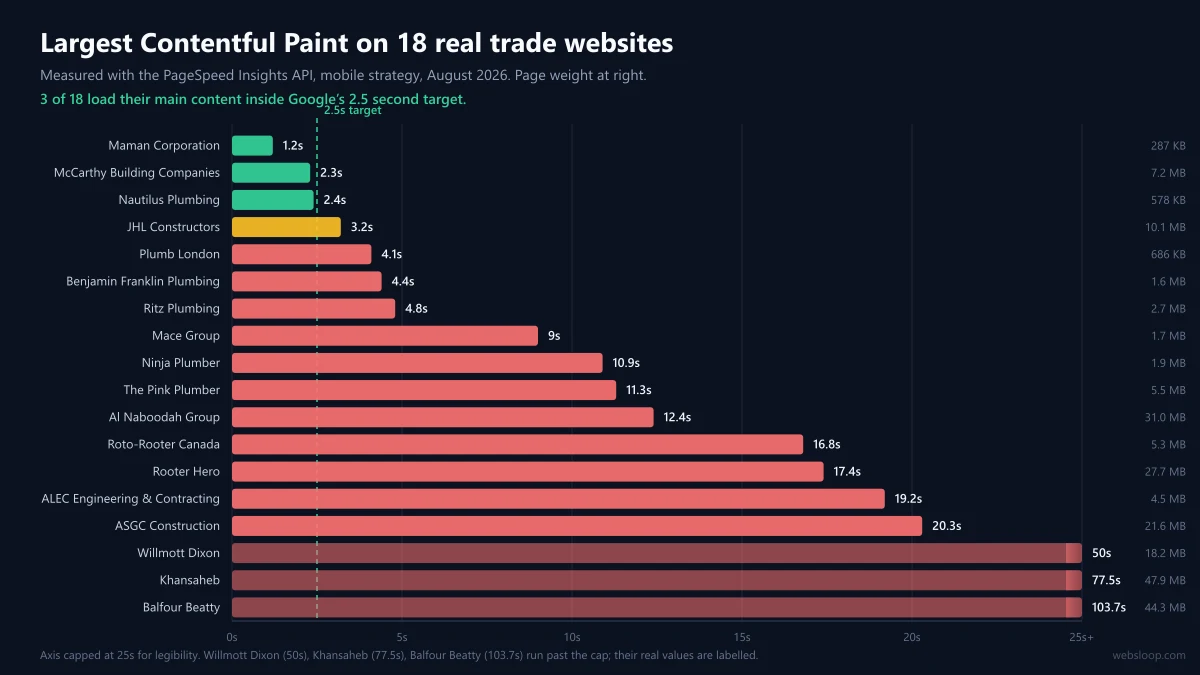
Speed matters on town pages too, because they are opened on phones by people standing in the town they searched for. Only 9 of the 342 roofing homepages we measured showed their main content inside Google’s 2.5 second target, and the median took 9.2 seconds. A town page built on the same slow template inherits the same problem, however well it is written.
What do roofers with strong local signals do differently?
Two of the roofing sites we re-measured on 26 September 2026 for our best roofing websites roundup show the local habits worth copying.
- Local Roofing covers southern Minnesota, northern Iowa and northern Wisconsin from three branches, and gives Fairmont, Albert Lea and Hayward their own tap-to-call numbers. A homeowner reaches the nearest crew, and each branch is clearly tied to its own area.
- Peak to Peak Roofing & Exteriors names the Denver-area towns it serves on the homepage, tells Google it is a RoofingContractor through structured data, and marks up its reviews, so its location, trade and reputation are stated in a form search engines can read.
Neither is doing anything expensive. They are simply specific about where they work and consistent about how they say it, which is most of local SEO.
How should a roofer with more than one branch handle local SEO?
Multiple locations add one rule on top of everything above: each place should look like its own local business, because to a homeowner searching in that town, it is. Treat a branch as real only if a crew or staff actually work from it. A mailbox or a desk you never visit is not a branch.
- Give each staffed branch its own Business Profile, with its own address, hours and local phone number.
- Give each branch its own page on your website, and link that profile to that page rather than to the homepage.
- Split your service areas between branches so they do not overlap, and each branch covers the towns it really serves.
- Ask customers to review the branch that did their roof, so each profile builds its own local history.
- Keep the company name identical across all branches, and let the page and profile say which town each one is in.
Local Roofing, from our measured set, shows the simplest version of this done well: each of its three branches has its own number on the website, so a homeowner in Fairmont, Albert Lea or Hayward reaches the crew closest to them. Nothing about that costs money, and it makes every branch easier for both people and Google to place on the map.
What happens to local search after a storm?
After hail or high winds, searches for roof repair and storm damage jump in the affected towns, and so does competition. Crews from other states often arrive, some with brand-new listings, all chasing the same homeowners. The roofers who hold their place in the map through that surge are usually the ones who prepared before it.
- Have a storm damage page live and indexed before the season, not written the week of the storm.
- Make sure “storm damage” or “roof inspection” is listed as a service on your profile.
- Post a short profile update when a storm hits, saying which towns you are inspecting and how fast you respond.
- Keep asking every storm customer for a review; recent reviews from the affected towns are the strongest local signal you can add that month.
Your advantage over an out-of-state crew is history: years of reviews, local photos and a real address or service area. Make that history easy to see, rather than trying to out-shout them.
How do you track local SEO results?
- Business Profile performance: calls, direction requests and website clicks from the map, month by month.
- Map-grid ranking: your position across your service area, checked monthly rather than from one address.
- Google Search Console: which town and service searches your website appears for.
- Your own call log: ask every caller how they found you, and note the town.
If you use a call-tracking number on your website to measure calls, keep your main business number consistent across the profile and every listing, so the tracking does not break the consistency that local rankings depend on.
A 30-day local SEO plan for a roofing company
| When | What to do |
|---|---|
| Days 1 to 7 | Fix the Business Profile: category, name, services, service areas, hours and photos. |
| Days 8 to 14 | Search your business name and old numbers, correct every listing, then claim Apple Maps and Bing Places. |
| Days 15 to 21 | Set up the review text and send it to every customer from the last three months. |
| Days 22 to 30 | List the towns that send you work, and plan one honest page for each, starting with the busiest. |
| Every month after | Check the profile for public edits, add new job photos, reply to reviews, and compare your map-grid ranking with last month. |
Most of this needs no developer. Where owners usually want help is the website half: town pages that read well, structured data and speed. We do that as a fixed-price project, and our roofing SEO services page lists exactly what each package includes. For the same steps across every trade, see our local SEO checklist for contractors.
Should you hire a roofing local SEO company or do it yourself?
Most of what moves the map pack is work an owner or office manager can do: the profile, the listings, the review habit and the monthly check. None of it needs special software, and nobody knows your service area, your jobs and your customers better than you do. If you have an hour or two a month and the discipline to keep asking for reviews, start there.
Hiring makes sense for the parts that are technical or time-consuming: building town pages that read well and do not look copied, adding structured data, fixing a slow site, cleaning up years of inconsistent listings, and setting up call tracking without breaking your details. That is the kind of local SEO roofing contractor owners most often hand off, and it is a defined job rather than an endless one. Whether you call the person doing it a local SEO consultant for roofing companies, a roofing local SEO agency, one of the roofers local SEO company options, an agency selling roofing local SEO services or local SEO services for roofers, someone offering Google Maps SEO for roofers, or a developer, the questions below apply the same way, because local SEO roofing contractors pay for should be judged on the same results.
What to ask a roofing local SEO company
- Exactly what they will change on your profile, your listings and your website, in writing.
- How they will report results: map-grid rankings across your area, calls and inspection requests, not just traffic.
- Whether any of their work touches your business name, addresses or reviews in ways Google’s guidelines forbid.
- Who owns the profile, the listings and the website if you stop working with them. The answer should be you.
- What it costs, and whether that is a one-off project or a monthly fee that never ends.
Be wary of anyone promising a guaranteed first place in the map. Distance alone makes that impossible for most of a roofer’s service area, and a promise that ignores it tells you how the rest of the work will be done.
What local SEO mistakes do roofers make?
- Keywords in the business name. Against Google’s guidelines and a common reason profiles get suspended.
- An address you do not staff. Risky, and it does nothing a proper service-area setup cannot do.
- Copied town pages. Doorway pages by Google’s definition.
- Listings with old numbers. Confusing for Google and a lost call for you.
- Buying or rewarding reviews. Against Google’s policy, and removable.
- Checking your rank from the office only. It hides every town where you are invisible.
- Setting up the profile and never touching it again. Recency is part of what Google and homeowners read.