SEO for roofers is the work that puts a roofing company in front of homeowners when they search Google, Google Maps or an AI assistant for roof repair, replacement or storm damage help in their town. In practice it comes down to five things: a Google Business Profile that is complete and active, a separate page for every roofing service and every town you cover, a steady flow of recent reviews, a site that loads fast on a phone, and business details that match everywhere they appear. This guide covers each one, with numbers we measured ourselves.
Roofing company owners search for this in several ways: SEO for roofing companies, SEO for roofing contractors, SEO for roofing company websites, SEO for roofing businesses, SEO for roof contractors, SEO for roof companies, or simply SEO for roofing. The longer versions ask the same question: search engine optimization for roofing companies, website search engine optimization for roofing company websites, website search engine optimization for roofing contractor sites, website search engine optimization for roofers, website SEO for roofers, website SEO for roofing contractors, or website SEO for roofing company owners who manage their own site, and so do searches for SEO strategies for roofing companies or SEO marketing for roofing companies. This guide answers all of them in one place, including the plainest one: how to make your roofer website SEO friendly. It is written for owners who want to understand the work before paying anyone for it, and it is honest about which parts you can do yourself this month and which parts usually need a developer.
A note on where the numbers come from. We measured 342 US roofing company websites on 13 September 2026 for our roofing website design study, and re-measured the best of them for our best roofing websites roundup. Search volumes come from Google Keyword Planner, Ahrefs and Semrush, and every outside claim links to its source at the end of the page.
What is SEO for roofers?
Search engine optimization for roofers is everything that decides whether your company shows up when someone near you searches for roofing work. It has two halves. The first is the map pack, the three businesses shown with a map above the ordinary results, which is driven mostly by your Google Business Profile, your reviews and your listings. The second is the organic results under the map, which are driven by your website: its pages, its speed and how clearly it says what you do and where.
Google says it ranks local results on three things: relevance, distance and prominence. Relevance is how well your profile and pages match the search. Distance is how far you are from the person searching, which nobody can change for you. Prominence is how well known and reputable you look, and Google names reviews and links as part of it. Every section of this guide works on relevance or prominence, because those are the two you control.
Roofing SEO differs from SEO for most businesses in three ways. The searches are local, so the map pack matters as much as your website. Demand jumps after storms, so pages have to be ready before the weather. And a single job is large, so one extra roof replacement a month can be worth more than thousands of visitors who never call.
Does SEO work for roofing companies?
It does, for the simple reason that homeowners search before they call. Google Keyword Planner puts “roofers near me” at 165,000 US searches a month, “roofing contractor” at 135,000 and “roof repair near me” at 90,500. Those are Google’s bucketed ranges rather than exact counts, but the scale is clear: every month, a lot of people are looking for exactly what you do.
The other way to be seen for those searches is to pay for each click. The table below shows what advertisers bid on Google Ads for some of the searches roofers want to win, from a Semrush US export pulled on 26 September 2026.
| Search | Monthly US searches | Google Ads cost per click |
|---|---|---|
| commercial roof replacement | 12,100 | $30.49 |
| commercial roofing near me | 12,100 | $31.65 |
| metal roofing contractors | 5,400 | $23.44 |
| roof leak repair near me | 5,400 | $24.29 |
| commercial roof repairs | 3,600 | $35.50 |
| commercial roof replacement near me | 1,300 | $40.70 |
Ten ad clicks on “roof leak repair near me” cost about $243 whether or not anyone calls. A page of yours ranking for the same search costs nothing per click. That is the case for SEO in one line: you pay once for work that keeps bringing calls, instead of paying for every visitor. The trade-off is time, which the section on timelines covers honestly.
One more signal worth knowing. Roofers themselves are searching for this far more than they used to. In Ahrefs, searches for “seo for roofers” averaged about 890 a month two years ago and about 1,470 a month over the last six months. Your competitors are reading guides like this one, which is a reason to start rather than wait.
What do homeowners search for when they need a roofer?
Keyword research for a roofing company is less about finding clever phrases and more about listing the jobs you want and the places you want them. Almost every roofing search names a service, a roof type or a place, and many name all three. We group them into four buckets, because each bucket needs a different kind of page.
- Service searches: roof repair, roof replacement, roof inspection, gutter installation, skylight repair. Each needs its own page on your site.
- Material and roof-type searches: metal roofing contractors, asphalt roofing contractors, flat roof repair, tile roofing. If you install it, give it a page.
- Urgent and storm searches: emergency roof repair, roof leak repair near me, hail damage roof repair, storm damage roofing. These spike after bad weather and convert quickly.
- Place searches: roofing contractor plus a town, roofers near me, roof repair in a county. These are answered by the map pack and by your town pages.
A fifth bucket is questions: how much does a new roof cost, repair or replace, does insurance cover hail damage. These are earlier in the buying process, and they are where blog posts and FAQ answers earn their place. Answer them after your service and town pages exist, not before. For the full list with volumes, difficulty and cost per click, see our roofing SEO keywords list.
A practical tip. Tools disagree on volume, sometimes by a factor of ten, so read every number as a band. What matters is the order: build pages first for the services that pay you best and the towns with the most demand, and treat the exact figure as a guide rather than a fact.
A page map for a typical roofing company
Here is how those buckets turn into pages for a residential roofer covering one county. Your list will differ, but the shape is the same: one page per job, one per material you install, one per storm service, and one per town that sends you real work.
| Page | Example search it answers | What the page must show |
|---|---|---|
| Roof repair | roof repair near me | Common repairs, how fast you respond, photos of your own repairs |
| Roof replacement | roof replacement [town] | The process from inspection to cleanup, warranties, financing if you offer it |
| Metal roofing | metal roofing contractors | Types you install, finished jobs, how it compares with shingles |
| Storm damage | hail damage roof repair | Inspection steps, response time, how you work with insurance claims |
| Roof inspection | roof inspection near me | What you check, what the homeowner receives, what it costs |
| Each town you serve | roofing contractor [town] | Jobs done there, roof types common locally, drive time from your yard |
Six to ten service pages plus five to ten honest town pages is a realistic target for most roofers in the first year. Link each service page to the towns where you do that work, and each town page back to the services you offer there, so Google can see how the whole site fits together.
How do roofers get into the Google map pack?
For most roofing searches the map pack is the first thing a homeowner sees on a phone, and it is decided mainly by your Google Business Profile. Whitespark’s 2026 Local Search Ranking Factors report puts the primary Business Profile category at the top of the list of factors for local pack rankings. For a roofer that is almost always “Roofing contractor”, and it takes a minute to check. The full map-pack playbook, including listings, branches and storm surges, is in our guide to local SEO for roofing companies.
Set up the profile properly
- Choose the correct primary category, then add secondary categories only for work you really do.
- List every service, with a short description in plain English.
- If you work at customers’ homes rather than from a shopfront, hide your address and set service areas instead. Google allows up to 20 service areas and asks that the whole area stay within about two hours’ drive of your base.
- Use your real business name. Adding keywords or towns to the name breaks Google’s guidelines and can get the profile suspended.
- Add photos of your own crews and finished roofs, and keep adding them as jobs finish.
Keep reviews coming
Reviews feed prominence, and homeowners read them before they call. BrightLocal’s 2026 Local Consumer Review Survey found 97% of consumers read reviews for local businesses and 74% look for reviews from the last three months. So a roofer with 150 reviews and nothing recent can lose to one with 40 reviews from this season.
The fix is a habit, not a campaign. Send a short text with your review link on the day each roof is finished, while the homeowner is still pleased. Reply to every review, good or bad, within a few days. And never offer anything in return: Google’s Maps content policy prohibits businesses from offering payment, discounts or free services in exchange for reviews.
Make your details match everywhere
Your name, address and phone number (often shortened to NAP) should read exactly the same on your website, your Business Profile, and every listing: Yelp, BBB, Angi, HomeAdvisor, Houzz, Nextdoor and any trade directory. These listings are called citations, and they help search engines confirm you are one real business. Old phone numbers and past addresses are the usual culprits, so search your own business name and fix what you find.
What does a roofing website need to rank?
The map pack gets you seen, but homeowners click through to your website before they call, and the organic results under the map depend on it entirely. When we measured 342 roofing company homepages, the basics were missing far more often than you would expect.
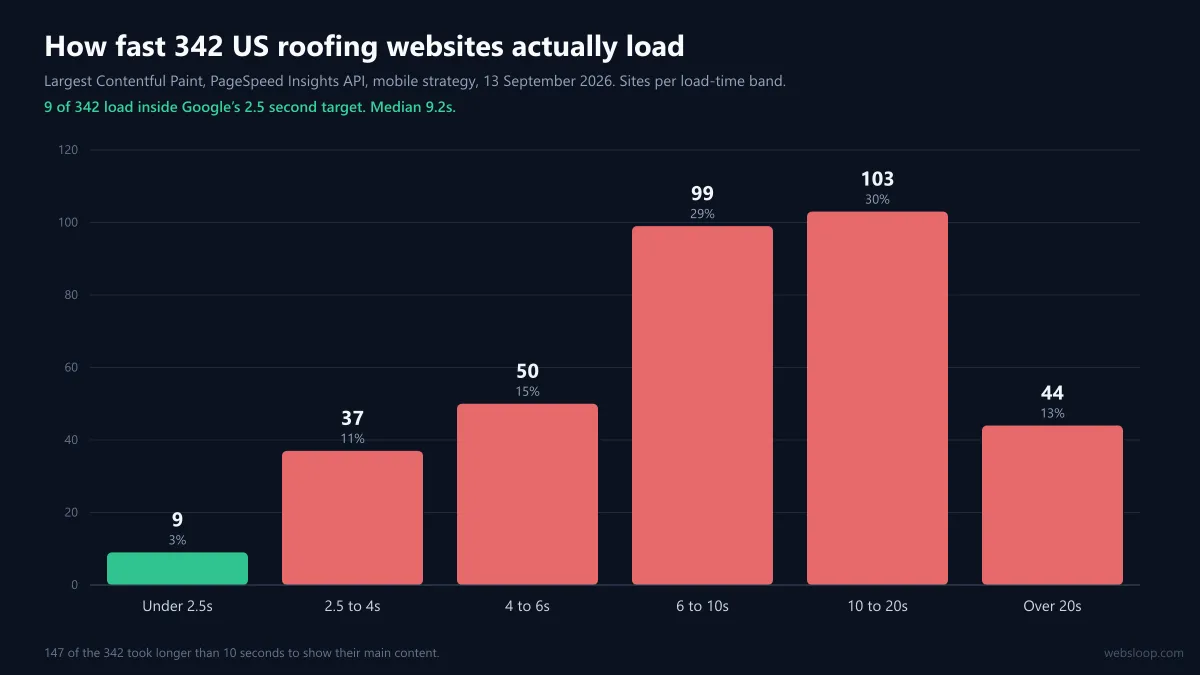
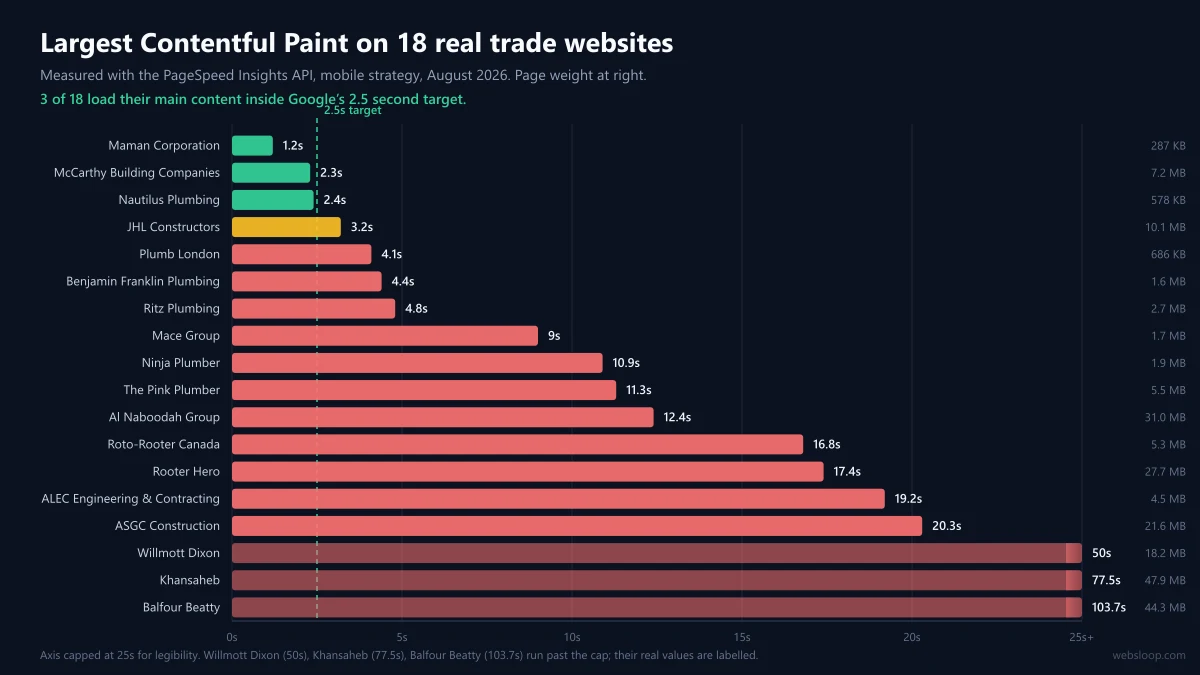
- Speed: only 9 of 342 showed their main content inside Google’s 2.5 second target on a phone. The median took 9.2 seconds.
- Structured data: 51 carried none at all.
- A way to call: 77 had no tap-to-call link.
- A way to ask for an inspection: 144 had no form on the homepage.
One page per service, one page per town
A single “Services” page listing repair, replacement, gutters and storm work cannot rank well for any of them, because Google matches one search to one page. Give each service its own page that explains the work, shows your photos of it and says where you do it. Then give each town that matters its own page, written about the work you actually do there: jobs completed nearby, the roof types common in the area, how quickly your crew arrives.
Be careful with town pages. Copying one page and swapping the town name is exactly what Google’s spam policies describe as doorway abuse: pages created to rank for specific, similar searches. Ten honest town pages beat a hundred copies.
Tell Google you are a roofer
Schema.org publishes a RoofingContractor type, which sits under LocalBusiness and carries your service area, opening hours and contact details. Adding it is a few lines of code, and it tells search engines and AI assistants exactly what you are instead of leaving them to guess. Of the ten pages ranking for this search that we read, not one mentioned it. Of the eight fastest roofing sites we featured in our roundup, only two used it.
Speed and the phone
Most roofing searches happen on phones, often standing in a driveway looking at a leak. A page that takes nine seconds to show anything loses that visitor before your number appears, however well it ranks. Compress your photos, remove plugins you do not use, and test your homepage free in Google PageSpeed Insights. Then put a tap-to-call number and a short inspection form on every page, not just the contact page.
What do roofing websites that get SEO right look like?
Real examples help more than rules. These five come from the roofing sites we re-measured on 26 September 2026 for our best roofing websites roundup. Each does something well that any roofer can copy, and each also shows a gap, because none of them is perfect.
- Peak to Peak Roofing & Exteriors (Denver area): the lightest homepage of the eight at 414 KB, six tap-to-call links, and the best structured data we found: it tells Google it is a RoofingContractor and marks up its reviews. It also leads with hail damage, which fits a Colorado roofer. The gap: the main call to action sends visitors to a separate contact page instead of a form on the homepage.
- Northpoint Roofing Systems (Georgia and Tennessee): the most complete set of lead tools, with a call button, a schedule button, a complimentary inspection offer and a 4.7 rating from 611 reviews shown on the page. The gap: its main content loaded just outside Google’s 2.5 second target on our mid-range phone test.
- Local Roofing (Minnesota, Iowa and Wisconsin): proof a Wix site can do well. Each branch, Fairmont, Albert Lea and Hayward, has its own tap-to-call number, so a homeowner reaches the nearest crew. The gap: no homepage form and no structured data, the two cheapest fixes on the page.
- WS Aiken (Boston and New England): it knows its buyer and speaks to universities, hospitals and facility managers, with RoofingContractor schema in place. The gap: at 8.6 MB the homepage is heavy, which a visitor on a weak signal pays for.
- Kirberg Company (Missouri): roofing since 1920, and it uses that history well with concrete credentials on the page. The gap: no structured data at all, leaving Google to work out on its own what the business is and where it works.
What the five have in common
The pattern across all five: the sites that do well are specific. They say what they do, for whom and where, in the first screen, and they make calling easy. The gaps are almost always the same two cheap ones, missing structured data and a missing form.
How should roofers handle storm season and insurance searches?
Roofing demand follows the weather. Hail in spring, wind and hurricanes later in the year, ice dams in winter, depending on where you work. The searches arrive the morning after the storm, not weeks later, and a new page can take weeks to be indexed and months to rank. So storm pages have to be built and live before the season, not written in a rush once the phone starts ringing for somebody else.
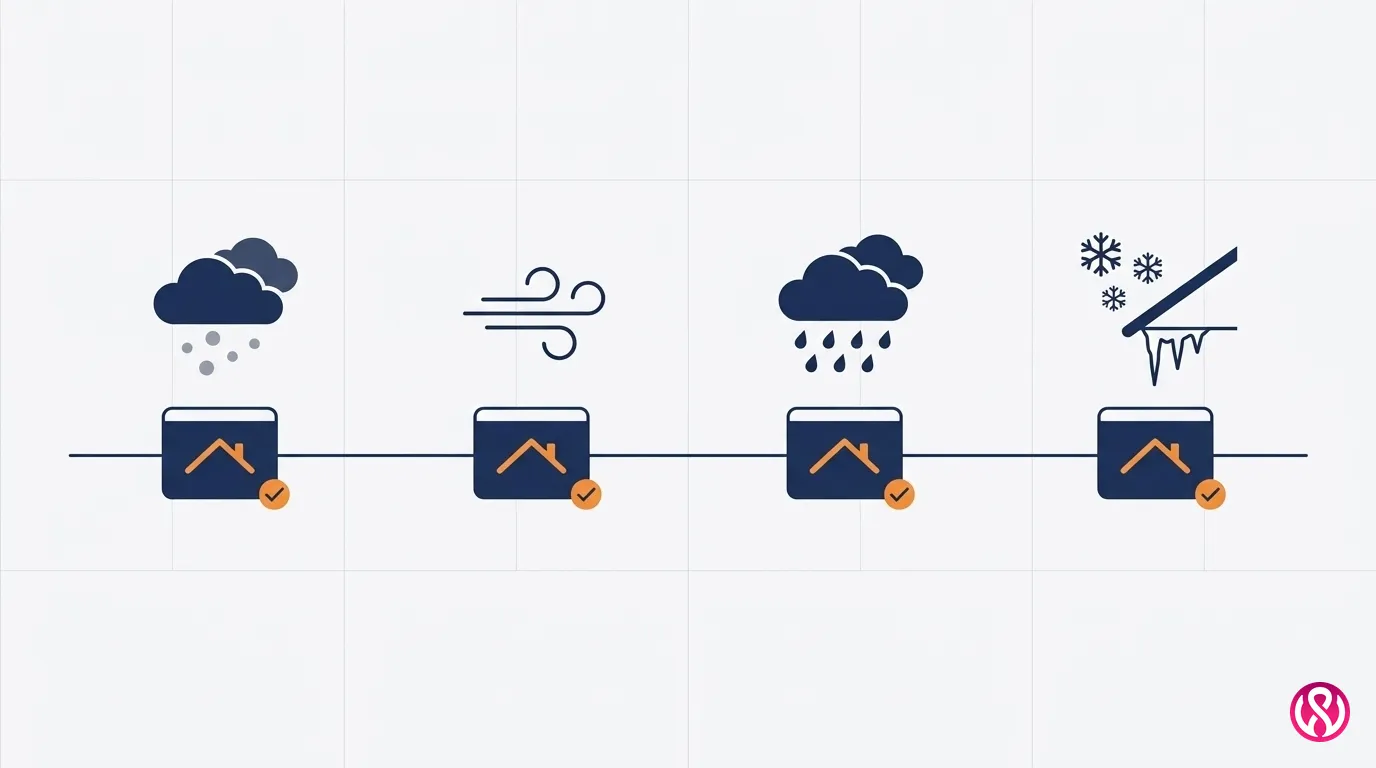
Build one page each for the storm work you do: hail damage, wind damage, emergency tarping, leak repair. On each one, say what happens during an inspection, how fast you respond, and how you work with insurance claims, because that is what a homeowner with a damaged roof wants to know first. If you help with claims, explain the steps plainly. If you do not, say so, which saves both of you a wasted call.
Two cautions. Do not publish promises about what insurance will pay, because only the insurer decides that. And do not create a page for every town you have never worked in just because a storm passed through, which runs straight into the doorway problem above.
How do roofing companies get backlinks?
Links from other websites to yours are part of prominence, but for a local roofer a handful of real, local links is worth more than hundreds from sites nobody reads. Google’s spam policies are explicit that buying or selling links for ranking purposes counts as link spam, so the only safe links are ones you earn.
- Your manufacturer’s contractor locator, if you hold a certification with a shingle or metal roofing brand.
- Local trade associations, your chamber of commerce and home builders’ associations that list members.
- Suppliers and partners who list the contractors they work with.
- Local sponsorships, such as youth sports teams or charity events that thank sponsors on their site.
- Local news coverage of a real story: a roof donated to a family in need, or storm response in your town.
None of these is quick, and that is why they work. A competitor cannot buy their way past a link from your local chamber of commerce.
Put together, the sections so far are a complete roofing company SEO strategy: pages that match what homeowners search, a profile and reviews that win the map, a site that loads and proves who you are, and links you earned locally. That is roofing organic SEO in full, before a single ad is bought, and it is the same whether you run one crew or ten.
How do roofers show up in ChatGPT and AI Overviews?
More homeowners now ask ChatGPT, Perplexity, Gemini or Google’s AI Overviews who to call or what a new roof should cost, which is why ChatGPT SEO for roofers has become its own search. These tools pull their answers from pages that state things clearly, so the same work that helps SEO helps here, with a few habits worth adding.
- Write headings as the questions homeowners ask, and answer each in the first two sentences under it.
- Use the RoofingContractor schema and keep your name, address and phone identical everywhere.
- Put real specifics on the page: towns you serve, materials you install, warranties you offer, years in business.
- Add an FAQ to service pages, answered from the questions customers actually ask you on the phone.
There is no separate trick for AI search. A page that clearly answers a question, from a business that looks the same everywhere it appears, is what these tools are built to find.
How long does roofing SEO take, and how do you measure it?
This is the question behind every search for how to rank my roofing website on Google, and behind most searches for Google SEO for roofers: when will it work, and how will I know? It is also what every SEO roofer owners hire should answer before they start.
Fixes to your Business Profile, speed and schema are often picked up within weeks. New service and town pages usually take several months to climb, and longer in a large metro or on a new domain Google has barely seen. Nobody can promise a date. Google’s own advice on hiring an SEO says it plainly: no one can guarantee a number one ranking.
Measure it with three free tools and one habit.
- Google Search Console: which searches your pages appear for, and how often people click.
- Your Business Profile performance report: calls, direction requests and website clicks from the map.
- Google Analytics 4: form submissions and tap-to-call clicks, set up as key events.
- Ask every caller how they found you, and write it down. Nothing beats it.
Judge the work by calls and inspection requests from your own service area, not by traffic. Visits from three states away feel like progress on a chart and pay nothing.
SEO, Google Ads, Local Services Ads or lead sites: which first?
They do different jobs. Google Ads and Local Services Ads bring calls this week and stop the day you stop paying. Lead sites such as Angi and HomeAdvisor are quick to start, but you pay per lead and the same homeowner may be sent to other roofers too. SEO takes months and then keeps bringing calls without a cost on each one.
Most roofing companies end up using a mix: paid channels during storm season or while SEO builds, and SEO as the base that stays when the budget is switched off. The side-by-side comparison of all four is on our contractor SEO services page, and published cost per lead for each channel is in our roofing lead generation guide.
Should you do roofing SEO yourself or hire someone?
A lot of it you can do yourself, and you should do the first month before paying anyone. Here is the order we would work in.
- First week, the profile: fix your Business Profile category, services, service areas and photos, and search your business name to find listings with the wrong details.
- Second, reviews: set up the review text and send it to every customer from the last three months.
- Then speed and calls: test your homepage in PageSpeed Insights and on your own phone, and make sure the number taps to call on every page.
- By the end of the month, the page list: write down the services and towns that do not have their own page yet, in order of how much each job is worth to you.
Where most owners get stuck is the technical half: speed fixes, schema, pages competing with each other, and working out why a good page is not ranking. That is the point to bring in help. Ask whoever you hire for examples of their work, what results they expect and when, and exactly what the price includes. Walk away from anyone who guarantees rankings.
We do that technical half as a fixed-price project rather than a monthly retainer, and our roofing SEO services page lists exactly what each package covers. The step-by-step version of the do-it-yourself work is in our local SEO checklist for contractors.
Roofing SEO at a glance
| Area | What good looks like | Do it yourself? |
|---|---|---|
| Business Profile | Right category, all services, service areas, fresh photos | Yes |
| Reviews | A new review most weeks, every one answered | Yes |
| Listings | Name, address and phone identical everywhere | Yes |
| Service and town pages | One page per job and per real town | Partly: the writing yes, the structure often needs help |
| Speed | Main content in about 2.5 seconds on a phone | Usually needs a developer |
| Schema | RoofingContractor with service area and hours | Usually needs a developer |
| Storm pages | Live and indexed before the season | Yes, if you plan ahead |
What roofing SEO mistakes should you avoid?
- Copied town pages. Doorway pages under Google’s spam policies, and a drag on the pages that are good.
- Bought links and link packages. Link spam by Google’s definition, and a risk to the whole site.
- Paying or discounting for reviews. Against Google’s Maps content policy, and reviews can be removed.
- Keywords stuffed into your business name. Against Business Profile guidelines, and a common cause of suspensions.
- Stock photos of someone else’s roofs. Homeowners notice, and they add nothing that proves you do the work.
- A slow, heavy homepage. The most common failure in our study, and the one that wastes every other fix.
- Judging SEO by traffic. Count calls and inspection requests from your towns instead.
If you want a second pair of eyes on where your own site stands, we will look at it for free and tell you which of these apply, including when the honest answer is that you can fix them yourself.