
A website redesign takes 2 weeks for a five-page Starter build, 3 to 4 weeks for a Professional build, and 4 to 8 weeks for a full Enterprise site with us. Across the wider market, most redesigns run 6 weeks to 6 months depending on scope, in the same range as HubSpot's own survey of over 6,000 businesses, which puts the traditional redesign at 3 to 4 months. The number one reason any of them run long has nothing to do with design or code.
How Long Does a Website Redesign Actually Take?
The honest answer is a range, because a five-page brochure site and a fifty-page multi-location site are not the same job. Industry-wide, timelines break down roughly by size:
| Site size | Typical timeline | What drives it |
|---|---|---|
| Small (5 to 20 pages) | 4 to 12 weeks | Content readiness, feedback speed |
| Mid-sized (10 to 30 pages) | 8 to 16 weeks | Number of unique templates, integrations |
| Large (50 to 200+ pages) | 16 to 24 weeks | Content migration, stakeholder approvals |
Those ranges assume a client who has content ready and turns feedback around quickly. Add a slow approval chain or unwritten copy, and any of these numbers can stretch by a month or more.
Our Own Timeline, Tier by Tier
Rather than quote a range and scope it later, our website redesign service ties its timeline to the same published packages that set the price:
- Starter ($799): 2-week delivery, up to 5 responsive pages.
- Professional ($1,499): 3 to 4 week delivery, up to 10 responsive pages.
- Enterprise ($2,499+): 4 to 8 week delivery, 15+ pages (or unlimited).
That timeline holds because writing genuinely different content for every page is the slow part, not the design templates that hold it. A five-page site has a fifth of the writing a twenty-five-page site does. That is most of why it also finishes in a quarter of the time.
What Actually Slows a Redesign Down
It is rarely the design or development work itself that pushes a redesign past its deadline. In client projects, two things account for almost every delay:
- Content that is not ready. Missing copy, photos or product descriptions stall a build even when the design is finished and approved.
- Slow or crowded feedback loops. Every extra reviewer added to an approval chain adds another round of waiting, and a project pauses every time a decision is outstanding.
Adding features mid-project is the next biggest cause, followed by switching platforms during the rebuild rather than after it. A rushed four-week enterprise build also costs more per hour than the same scope spread across ten weeks. Forcing overtime is more expensive than keeping a normal pace.
How Many Rounds of Revisions Are Normal?
Two to three rounds is the standard most agencies quote for a typical project. Round one covers structural and layout changes. Round two handles smaller refinements. A third round, if included, is final polish before launch. We tie the count to the tier instead of quoting a flat number for every project: Starter includes 1 round of revisions, Professional includes 2 rounds of revisions, and Enterprise includes unlimited revisions. Extra rounds beyond what a package includes are the most common reason a Starter-tier timeline slips past two weeks.
E-Commerce vs. Small Business Redesign Timelines
A brochure site with five to ten pages typically finishes in 4 to 8 weeks. An e-commerce redesign runs longer, generally 8 to 20 weeks. Product catalog migration, payment gateway testing and checkout logic each need their own testing pass before launch. Data migration and integration testing drive an e-commerce timeline far more than the visual design does. On the simpler end, a WooCommerce store can still hit an 8-week mark. A larger, custom-built store with a big catalog can run 14 to 16 weeks. For context on just how much catalog and integration work can add, Clutch's own client-review data puts the average full e-commerce development project, not a redesign specifically, at 9 months start to finish once sourcing and catalog buildout are included.
One Real Project's Timeline, Start to Finish
We redesigned Carter Hearing's site, four clinics and two mobile hearing-aid units across British Columbia, in 4 weeks. That included image optimization that took the homepage from 4.2 MB to 840 KB. Mobile Largest Contentful Paint dropped from 6.8 seconds to 2.4 seconds before launch even happened. That is well inside the 2.5-second threshold Google publishes for a good score.
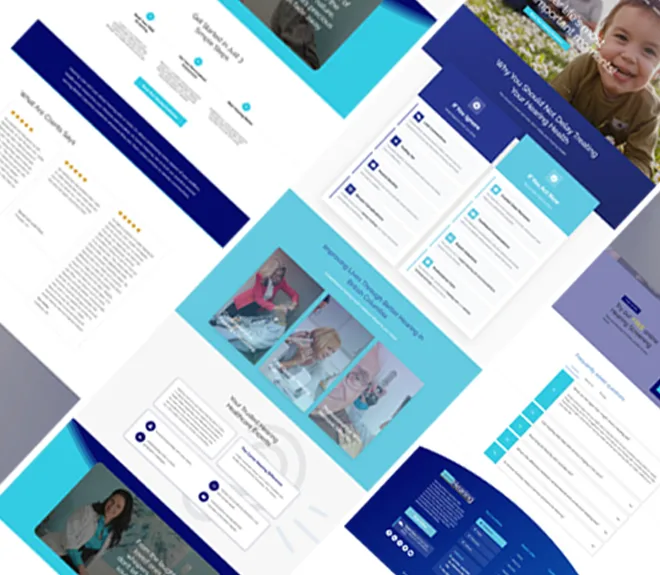
Carter Skin, a med spa running two clinic locations, took 5 weeks for a full redesign across both locations on Wix. Two real projects, two different timelines, both inside the range their tier promised.

Can You Speed Up a Website Redesign Without Cutting Corners?
The fastest lever available is entirely on the client side. Have copy, images and logins ready before the project starts, and turn each round of feedback around within the agreed window instead of letting it sit for a week. Cutting scope to save time almost always costs more later in fixes. Cutting your own response time costs nothing and shortens the project by exactly as many days as it saves.
Migrating to a new platform while also redesigning is the other lever, and it runs the opposite way. Every existing page, product and URL has to move without breaking, on top of the design work itself. That is slower than redesigning first and migrating separately. Google's own guidance on site moves exists for a reason. Skipping the redirect-mapping step during a platform switch, not the redesign itself, is where rankings actually get lost.
Phased Rollout or Launch Everything at Once?
Launching everything at once keeps the experience consistent. It suits sites under roughly 30 pages, where the whole rebuild is small enough to test as one unit. A phased rollout gets the homepage and highest-traffic pages live sooner. It also lets a global bug get caught and fixed once, instead of showing up across two hundred pages three months later. The larger the site, the more a phased approach tends to make sense. For a typical small business site, one clean launch is usually simpler and safer.
Keeping Your Redesign on Schedule
Three things protect a timeline more than anything written into the contract: content ready before kickoff, feedback turned around inside the agreed window, and scope agreed in writing before the build starts. Ask any agency quoting your redesign for a delivery date tied to a specific page count and revision count, the same way our own tiers are. A slipping timeline should show up as a conversation. It should never be a surprise.
Full pricing for each tier, including exactly what's included at every timeline, is in our website redesign cost breakdown. For the phase-by-phase version of this same timeline, discovery through launch, see the website redesign timeline. If rankings during the move are the bigger worry, we cover that separately in website redesign without losing your rankings.