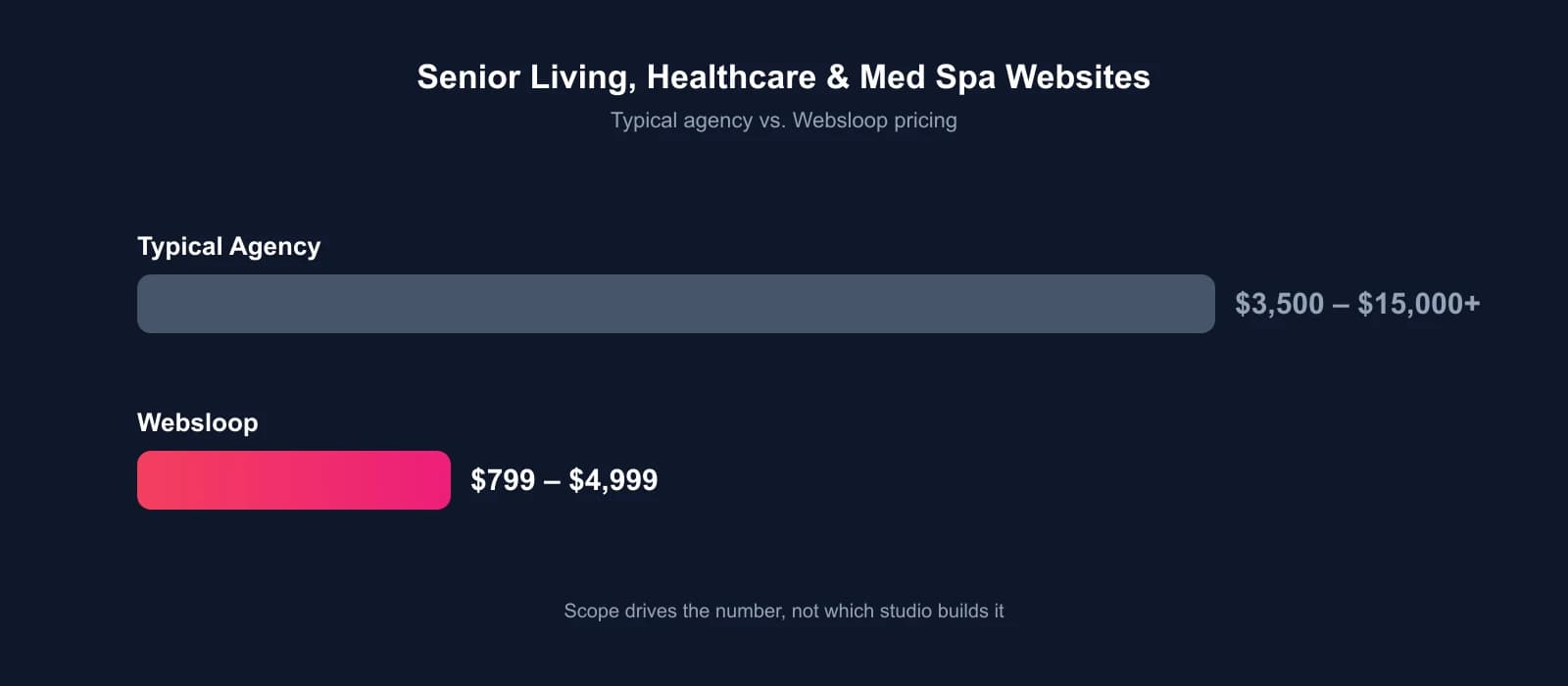
Senior living web design, along with healthcare and med spa websites, runs $3,500 to $15,000 or more at most agencies. The number moves almost entirely on scope, not on which company builds it. Here is what a real project in this space actually needs. That includes what it should cost, and three real results from projects we have shipped in exactly this vertical.
The search terms vary by vertical, but the underlying project is the same either way. Some people look for a healthcare web design company, others search assisted living website design or medical spa website design, and others just want a straight answer on senior living website cost. Whatever the phrasing, the real cost drivers and real requirements below apply the same way.
What Senior Living, Healthcare & Med Spa Websites Actually Cost
Semi-custom and custom scope are the two real cost drivers. Per IlluminAge's own senior living pricing, expect $3,500 to $5,500 for a smaller semi-custom site. A small custom project runs $5,500 to $10,000. One large site, or a family of sites across multiple locations, can exceed $10,000. Photo galleries, virtual tours, and multi-location setups are the usual reasons a quote climbs toward the higher end. Healthcare and med spa quotes track a similar range. Our own packages cover the same scope at $799 to $2,499, fixed and agreed in writing before work starts. The gap is not corner-cutting. It is a smaller studio without an agency's overhead, doing the same work.
HIPAA Compliance: What a Real Med Spa or Healthcare Website Needs
Per a real HIPAA compliance guide for medical spas, any form collecting health information counts as protected health information. That includes medical history, medications, allergies, or symptoms, and it must be handled accordingly. A Notice of Privacy Practices explains how patient information is used and protected. It must be given to every new patient, posted at the practice, and published on the website itself. Before-and-after photos count as protected health information too. They need a specific, separate written authorization from the patient, not a general consent form signed at intake.
Booking is the other piece that has to be handled correctly. A contact form that asks about symptoms or treatment history is collecting health data the same way an intake form does. That means the booking platform itself needs to be HIPAA-aware, not just the paperwork around it.
Real Example: Falcon Ridge, a Senior Living Community
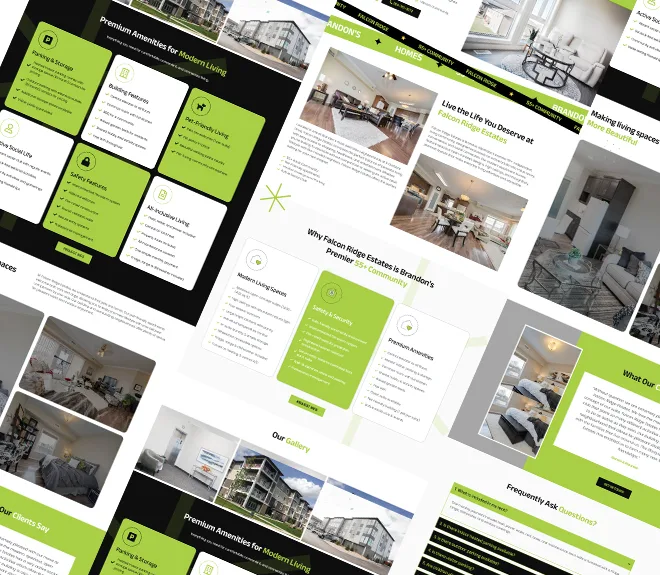
Falcon Ridge Estates is a 55+ independent living community with three property locations in Brandon, Florida. Their old site loaded in over 8 seconds on mobile and had no local search presence at all. We rebuilt it as a custom, hand-coded WordPress site with local SEO built in from day one. That meant schema markup, Google Business Profile optimization, and location-specific content for each property. Results: 285% more organic traffic and 60% more enquiries, delivered in 6 weeks.
Real Example: Carter Hearing, a Multi-Location Healthcare Practice
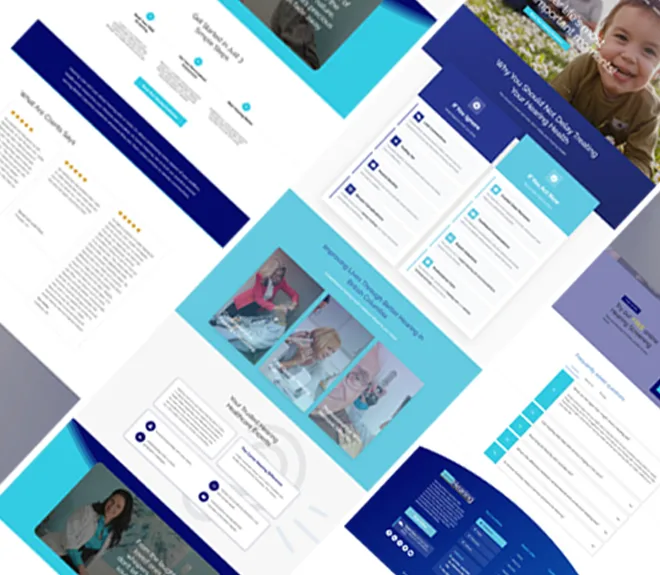
Carter Hearing is a hearing healthcare practice running four clinics and two mobile units across British Columbia, competing directly against corporate hearing-aid chains. We redesigned the site on Wix around their real local, family-owned positioning. Each of the six service points got its own real location page. Booking connected directly to JaneApp, one of the HIPAA-aware platforms named above, rather than leaving visitors stuck on a generic contact form. Result: 180% more organic traffic.
Real Example: Carter Skin, a Two-Location Med Spa
This is exactly the kind of med spa web design project that shows what the cost drivers above look like in practice.
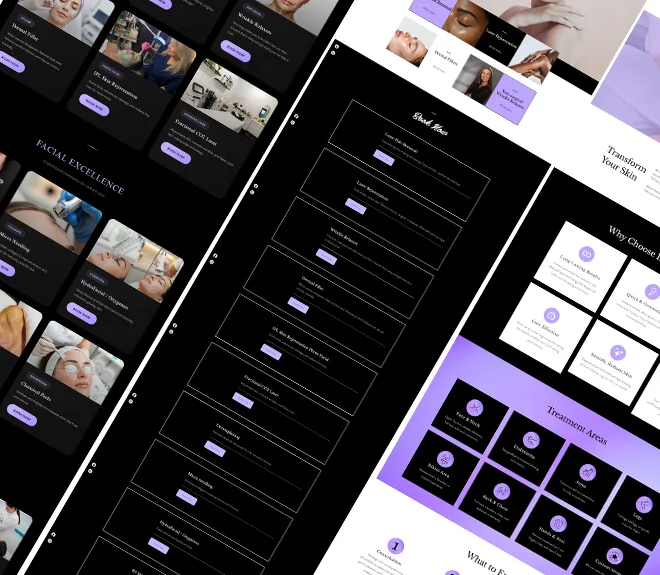
Carter Skin & Wellness came to us with a site that undersold their laser, injectable, and skincare treatments, and made booking harder than it needed to be across their two clinic locations. Over 70% of their visitors browse on a phone, so the redesign was mobile-first from the start. That meant a fast, frictionless Wix Bookings flow, treatment pages with clear benefit and pricing information, and the trust signals a high-trust aesthetic category actually needs before someone books.
WordPress or Wix: Which Platform Actually Fits This Vertical
There is no single right platform for this vertical, and the case studies above prove it. Falcon Ridge runs on custom WordPress because a 55+ community with three properties needed deep local SEO control: schema markup tuned per location, a hand-coded theme built for sub-2-second load times, and full flexibility for future property additions. Carter Hearing and Carter Skin both run on Wix, and that was the right call for a different reason. Both are multi-location healthcare and med spa practices where the priority was getting a polished, trustworthy site live fast with a reliable booking integration, not building custom infrastructure for its own sake.
The decision comes down to what the practice actually needs, not a fixed preference for one platform. A single-location med spa opening for the first time rarely needs WordPress's flexibility. A senior living operator planning to add properties over the next five years usually does. Getting this choice wrong shows up later as a rebuild nobody budgeted for, which costs more than picking correctly the first time.
What Actually Makes These Websites Convert
Across all three of these, the pattern is the same. Mobile has to work properly, since most visitors researching a senior living move or a med spa treatment are on a phone, not a desktop. Booking has to connect to a real system, not a contact form that generates a follow-up email two days later. The content has to be written for the actual decision too. That might be a family choosing a community for a parent. It might be a first-time client deciding whether to trust someone new with an aesthetic treatment. Either way, a list of services with no context for why any of it matters does not make that decision easier.
Photography carries more weight in this vertical than most others, and it needs handling correctly on both fronts. A senior living site with real photos of the actual community, not stock images of unrelated retirees, builds trust a generic template never will. A med spa or healthcare site showing real treatment results needs the written photo authorization covered earlier, every time, with no exceptions for a photo that seems harmless. Skipping that step is one of the most common compliance mistakes in this space, not because anyone means harm, but because it is easy to forget when a real result looks good enough to want to show off immediately.