Website Redesign

SEO-Safe Redesign Migration

A structured process for preserving search rankings during a redesign: URL mapping, metadata migration, redirect setup, and a crawl before and after launch to verify nothing was lost.

Falcon RidgeCarter HearingCascadiaSTRInvoicyAimo XAiden Van NielenA-Team PaintingM8owes ConstructionON ArchitectureRe-AmpedPremier PaintingHunter SkylightsMaintecSparky Solar
Overview

What SEO-Safe Redesign Migration involves

A redesign that drops your organic traffic by 30% in the weeks after launch is not a successful redesign, even if the new site looks better. This is the most common outcome of a redesign that treats SEO as an afterthought. URLs change without redirects, metadata is reset to defaults, canonical tags are misconfigured, and Google has to re-crawl and re-evaluate every page from scratch.

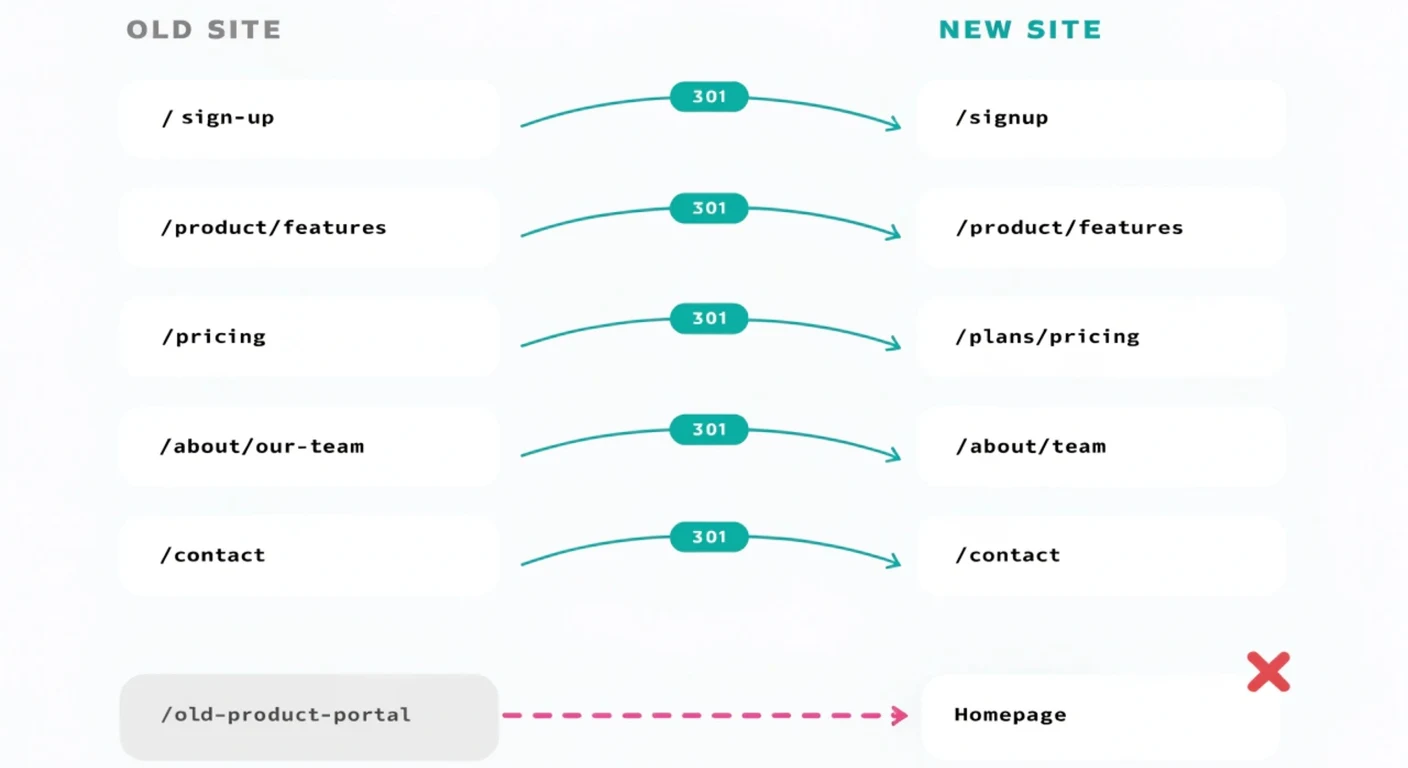
This is what search engines call SEO-safe migration, though most teams search for it as site migration SEO, seo website migration, or an seo migration checklist. Different name, same underlying process: a systematic sequence that prevents the outcomes above. Every URL is mapped before launch. Redirects are deployed and tested before the DNS switch, and metadata is migrated and verified. A post-launch crawl then confirms the new site is structurally identical to the old one from Google's perspective.


What you get

  • URL structure preservation
  • Metadata migration
  • Redirect implementation
  • Pre and post-launch crawl
1:1
URL Redirect Mapping
100%
Redirects Verified
10+
Years Exp.
4wk
Post-Launch Watch

Build stack

Screaming FrogGoogle Search ConsoleAhrefs / SemrushPageSpeed InsightsRich Results Test301 Redirect MappingXML SitemapGA4 Property Check

Get started

Tell us what you need. We will review the scope and give you an honest recommendation for your project.

Start a Project
Why it matters

What a strong build gets you

01

Rankings preserved through the transition

The most important outcome of a well-managed migration is that your organic traffic in the weeks after launch looks identical to the weeks before. That is the goal we design the process around.

02

Pre-launch verification, not post-launch recovery

Every redirect is tested before the DNS switch. Every metadata field is verified on staging. Problems are caught before they affect your live search presence.

03

Post-launch monitoring catches anything missed

We monitor Search Console for crawl errors, indexing issues, and ranking movements in the two weeks after launch. Fast response to any issue prevents problems from compounding.

How we approach it

How our approach differs

01

Pre-launch crawl documents every URL and metadata

We crawl the current site before the redesign goes live and extract every URL, title tag, meta description, H1, and canonical tag. This becomes the migration checklist, every element verified on the new site before DNS is switched.

This crawl is also the baseline for a post-launch comparison to confirm nothing was lost.

02

Redirects tested: not just implemented

After building the redirect map, we test every redirect to confirm it resolves to the correct destination with a 301 status. Chains (A → B → C) are flattened. Loops are identified and removed. We do not consider the implementation complete until the test crawl is clean.

03

Metadata migrated page by page, not in bulk

Title tags, meta descriptions, and canonical tags from the old site are applied to the new site page by page, not replaced with defaults. Schema markup is migrated and validated in the Rich Results Test. Errors on the old site are corrected during migration rather than carried across.

04

Post-launch monitoring for 4 weeks

After the DNS switch, we monitor Search Console daily for the first week and weekly for the following three weeks. Crawl errors, 404s, and unexpected redirect failures are caught and fixed before they compound into ranking drops.

Deliverables

What is included in the scope

Pre-launch crawl report

Complete inventory of all URLs, title tags, meta descriptions, H1s, and canonical tags on the existing site.

Tested redirect map

Full 301 redirect map implemented and test-crawled, every redirect verified to resolve correctly with no chains or loops.

Metadata migration verification

All title tags, descriptions, and canonicals checked on the new site against the pre-launch crawl data.

Schema migration

All structured data migrated and validated. Errors fixed during migration rather than inherited.

4-week post-launch monitoring

Search Console crawl errors, 404s, and ranking data monitored for 4 weeks after launch.

Relevant proof

Redesigns launched without losing rankings

Our SEO-safe migration process has been applied to site redesigns for service businesses and e-commerce stores. The consistent outcome is a Search Console ranking report that shows no significant movement in the weeks after launch.

  • Pre-launch crawl and metadata migration on every project
  • Tested redirect maps: not just implemented, verified with a test crawl
  • 4-week post-launch Search Console monitoring included as standard
View a redesign case study
Migration approach

SEO-safe migration vs redesign without a migration plan

Most ranking drops after redesigns are preventable. The difference is whether SEO was part of the launch process or added as an afterthought.

URL changes

Every changed URL gets a tested 301 redirect before DNS switch.

Changed URLs return 404s until Google recrawls and evaluates the new URL from scratch.

Metadata

Title tags and descriptions migrated page by page from the old site.

New site often launches with CMS default metadata until someone notices and fixes it.

Schema

Structured data migrated and validated in Rich Results Test.

Schema often missing or invalid on new site, losing rich result eligibility.

Post-launch

4-week monitoring catches any missed redirects or indexing issues.

Issues discovered by ranking drops weeks later, after the damage has compounded.

Launch QA

Checks before the page goes live

  • Pre-launch site crawl completed: all URLs, titles, descriptions, and canonicals documented.
  • Redirect map built, implemented, and test-crawled: no chains, no loops, no 404s.
  • All metadata verified on new site against pre-launch crawl data.
  • Schema markup migrated and validated in Rich Results Test.
  • Google Analytics 4 and Search Console verified tracking correctly after DNS switch.
  • Search Console crawl errors reviewed at 1 week and 4 weeks post-launch.
Honest fit

When this may not be the right choice

  • Your current site has very few indexed pages and no significant organic traffic, the SEO migration process adds most value when there are rankings to preserve.
  • You are making only cosmetic changes without touching the URL structure or metadata.
  • You are building a completely new site with a new domain rather than redesigning an existing one.
How we do it

Our process, step by step

01
Step 1

Pre-launch crawl

Full crawl of existing site. Every URL, title tag, meta description, and canonical tag documented.

02
Step 2

URL mapping

Every old URL mapped to its new destination. 301 redirects implemented and tested on staging.

03
Step 3

Metadata migration

Title tags, meta descriptions, and canonical tags verified on new site against old site data.

04
Step 4

Post-launch crawl

New site crawled after launch. Crawl errors, redirect failures, and metadata gaps flagged and resolved.

Fit check

Is this the right fit for you?

Use this section to decide whether a custom build is the right investment now, or whether a lighter update would be enough.

Best fit when

Your website needs to support growth, search visibility, clean editing, and a distinct brand experience.

Book a Free Consultation
Who it's for

Strong-fit situations

Each card describes a practical use case, not just a keyword variation. That keeps the page helpful and index-worthy.

  • Fit 01

    Businesses redesigning a site that currently ranks well

    Organic rankings represent years of accumulated authority. Losing them in a redesign through avoidable mistakes is expensive to recover.

  • Fit 02

    Site owners who have seen traffic drop 30 to 60% after a previous redesign

    Ranking drops after redesigns are almost always redirect or metadata problems. We can audit the current state and recover lost authority.

  • Fit 03

    Developers working on a redesign who want SEO handled by a specialist

    SEO migration is a distinct skill from web development. Bringing in a specialist for this phase means the developer can focus on the build without SEO being an afterthought.

  • Fit 04

    Organisations changing domain names or URL structures as part of a redesign

    Domain changes and structural URL changes are the highest-risk SEO events. A documented, tested migration plan is essential.

  • Fit 05

    Anyone who wants confirmation that their redesign is SEO-safe before going live

    A pre-launch SEO audit catches problems on staging before they affect live rankings. Prevention costs far less than recovery.

Get started today

Ready to get started?

Book a free 30-minute consultation. We will review your current situation and give you an honest assessment of what this service will do for your business. You leave the call with a fixed, itemized quote, not a range. Builds start at $799 and ongoing care plans at $99 a month.

FAQ

Questions about SEO-Safe Redesign Migration

Common questions about our seo-safe redesign migration service. These cover what the work includes, how we scope and price it, the timeline you can expect, and the support that follows launch. Pricing is fixed and agreed in writing up front. If something here is unclear, ask us and you will get a straight answer.

Still have questions? Get in touch →

More Website Redesign

The rest of this service, broken out so you can scope only the part you need. Each one is priced separately, and you are not required to take the whole service to get any single piece of it.

Testimonials

What Our Clients Say

Luis Peiró Sancho-Sopranis, Founder & CEO at Invoicy
Habib is an excellent, hard working and proactive developer. He is in charge of our public web and I have to say we are very happy both with the quality and speed of any work we ask him for. Communication with him is also very fluid. In summary, a great professional and great person. Recommended Websloop Agency!

Luis Peiró Sancho-Sopranis

Founder & CEO at Invoicy

Sources & authorship

Who wrote this, and what it is based on

Habib Ahmed, founder and lead developer at The Websloop
Habib Ahmed, founder and lead developer

Building client websites since 2015

Sources last checked 14 August 2026. Outside figures used on this page are listed here with their source, so you can check them yourself instead of taking our word for it.

Google treats a page as fast on three measures. Largest Contentful Paint under 2.5 seconds, Interaction to Next Paint under 200 milliseconds, and Cumulative Layout Shift under 0.1. All three are read at the 75th percentile of real page loads.

LCP should occur within 2.5 seconds of when the page first starts loading.
Core Web Vitals, web.dev (Google)https://web.dev/articles/vitals
Get in touch

Discuss Your Project

Tell us about your project and we'll respond within 24 hours. No pressure, just honest advice.

Project enquiry

Tell us what you're building

Service Needed

Free 30-minute consult, reply within 24 hours