
I audited 49 contractor websites this month, and the results surprised me. Not because the sites were terrible. Because they were not. The median site passed 10 of my 11 checks, and 14 sites passed all 11. The era of the broken contractor website is mostly over. What replaced it is subtler: sites that look finished and pass every technical test, yet quietly leak jobs through three specific gaps. Here is what the data says.
The short version
- 49 local contractor homepages scored (25 roofing companies, 24 plumbing companies, across 23 US states), each checked against 11 measurable criteria.
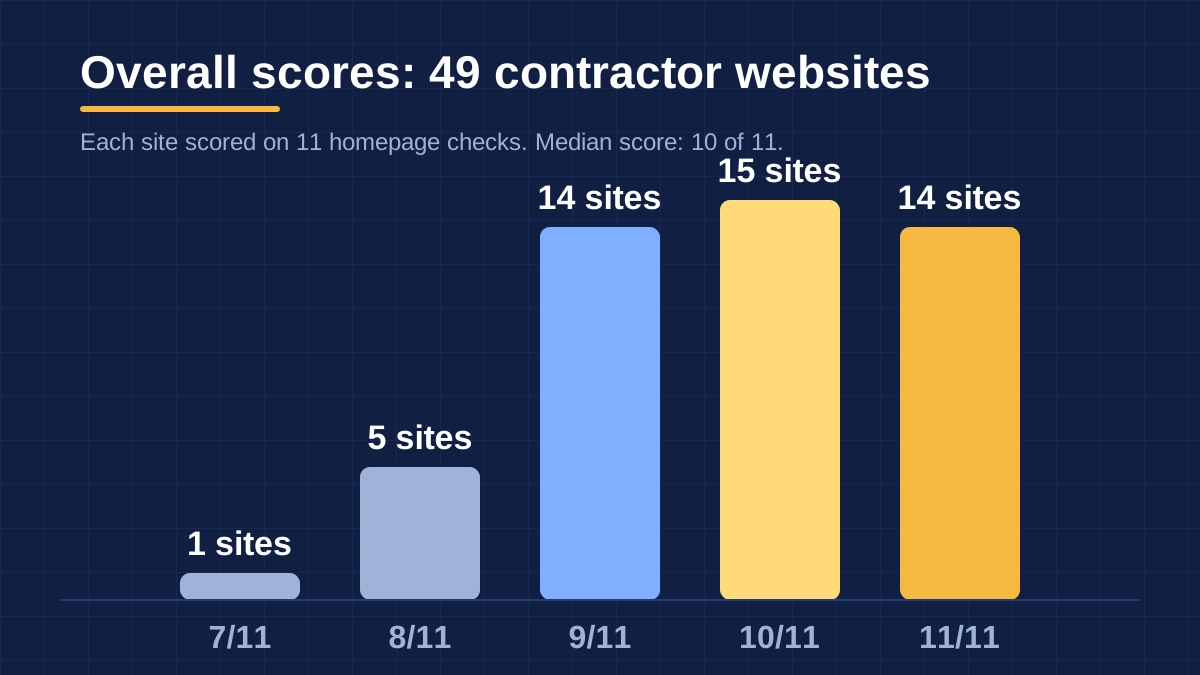
- Median score: 10 out of 11. 43 of the 49 sites scored 9 or higher. Only one site scored below 8.
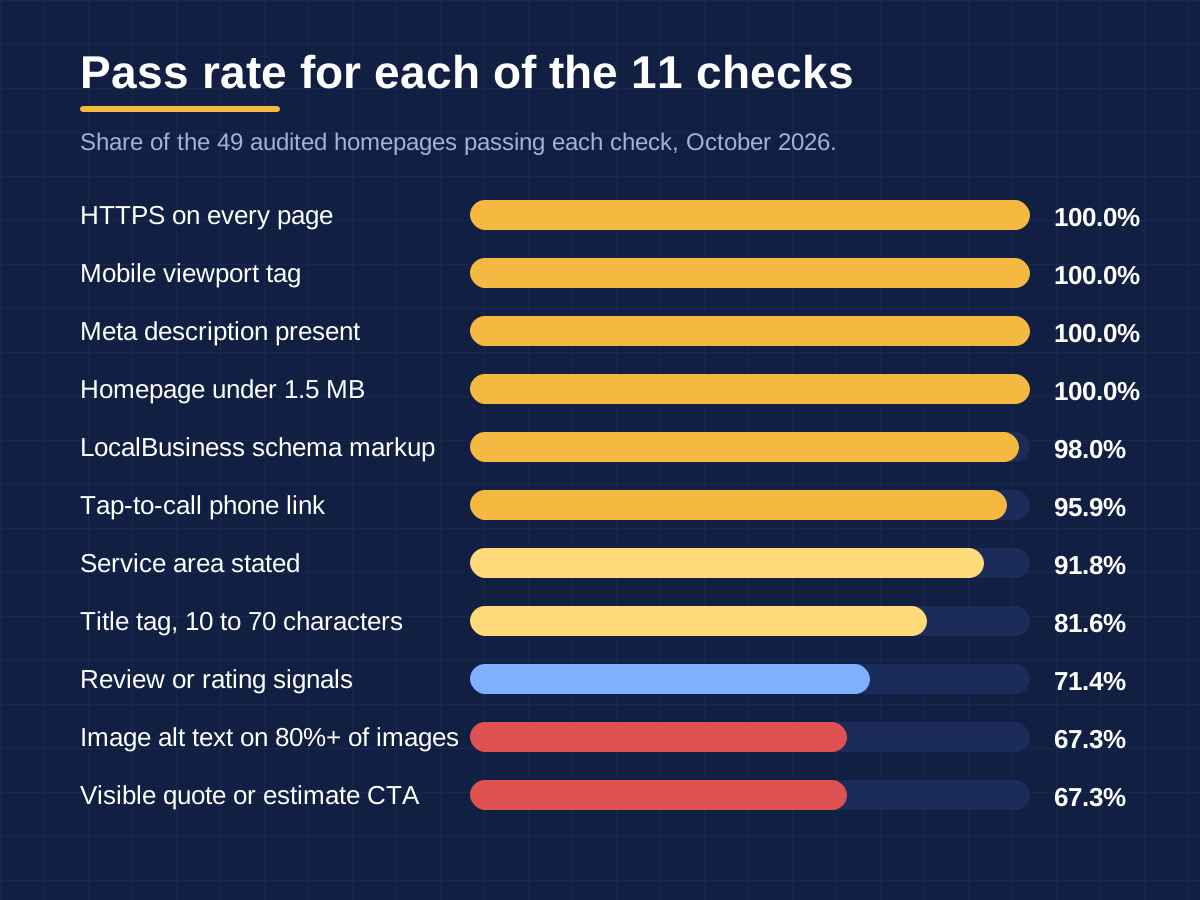
- The basics are nearly universal. Every site loaded over HTTPS, declared a mobile viewport, carried a meta description, and kept its homepage HTML under 1.5 MB. 48 of 49 had LocalBusiness schema markup. 47 of 49 had a tap-to-call phone link.
- The three real gaps are conversion gaps. Only 67% had alt text on at least 80% of their images, only 67% showed a visible quote or estimate call to action, and only 71% displayed review or rating signals. The failures are not technical. They are commercial.
- Roofers and plumbers scored almost identically (9.84 vs 9.62 average). Trade does not predict how good a website is. Habits do.
Why I measured instead of guessing
I am Habib Ahmed, founder and lead developer at Websloop, and I have been building contractor websites since 2015. I audit sites constantly, for prospects, for clients, for our own research. And I noticed my opinions were getting ahead of my evidence. Every agency has a list of "the mistakes contractors make," including us (we published ours in 7 Contractor Website Mistakes That Cost You Jobs). But a list of mistakes is an argument. I wanted a measurement.
So I built a sample and scored it. Fifty local roofing and plumbing company websites, picked through ordinary web searches across 23 states, no corporate chains, no franchises with national templates doing the work for them. Each homepage was fetched and checked against 11 binary criteria I can defend: HTTPS, a mobile viewport tag, a tap-to-call link, LocalBusiness schema, a sane title tag, a meta description, image alt coverage, a visible quote or estimate call to action, review or rating signals, a stated service area, and a homepage HTML weight under 1.5 MB. One site sat behind a bot-protection wall that refused automated fetches, so the scored sample is 49. Everything below is what those 49 homepages actually contained in October 2026.
How the audit worked, and what it cannot tell you
Honesty first, because a study that hides its limits is marketing. This was a homepage audit, not a full-site audit. The checks were automated HTML analysis, not a human clicking through on an iPhone. A viewport meta tag means the site declares itself mobile friendly; it does not prove the mobile layout is good. I deliberately did not score page speed, because a single server-side fetch from one location says nothing reliable about what your customer experiences on their phone. And the sample is 49 independent local companies found through search, which means it skews toward businesses visible enough to be found. Take the numbers as a snapshot of the findable local contractor web, not of every contractor with a domain.
That said, binary checks have a virtue opinions lack: two people running the same script get the same score. Here is the distribution.
The headline: the basics are nearly universal
If you built contractor websites for a living in 2015, you remember the wild west: HTTP sites, desktop-only layouts, no schema, phone numbers as images. That era is over, at least among findable local companies. Every one of the 49 sites loaded over HTTPS. Every one declared a mobile viewport. Every one had a meta description. Every homepage came in under 1.5 MB of HTML, with a median of 272 KB. Schema markup, the thing SEOs begged for for a decade, is now on 48 of 49 sites, mostly emitted automatically by SEO plugins. Tap-to-call links: 47 of 49. A stated service area: 45 of 49.
This matches what the better audit checklists now assume as table stakes. Hook Agency's contractor website audit checklist treats HTTPS, mobile layout, and clear calls to action as the starting line, not the finish. The industry's free tooling did the heavy lifting: WordPress plus an SEO plugin now ships most of these basics by default. The interesting story is not what the tools do for free. It is what they cannot do, which is where the scores fall off.
Gap 1: image alt text (67% pass)
Sixteen of the 49 sites had alt text on fewer than 80% of their images. The worst cases were not close calls: one homepage carried 230 images with alt text on fewer than 9% of them, another had 268 images at under 9%. These are gallery-heavy contractor sites, before-and-after photos, crew shots, truck shots, exactly the images a homeowner wants to see, published in a way Google Images cannot understand and screen readers cannot read.
This is the purest example of a gap no plugin fixes automatically. WordPress will happily publish 200 images with empty alt attributes forever. The fix is unglamorous: describe each image in a few words as you upload it, prioritizing the photos that sell the work. It is also an accessibility obligation, not just an SEO nicety, which is why it bothers me more than the score suggests.
Gap 2: the visible quote or estimate call to action (67% pass)
Sixteen sites had no visible "free quote," "free estimate," or "request a quote" call to action anywhere on the homepage. Think about that. A contractor homepage with no visible path to a price conversation is a brochure, not a sales tool. Sleek Web Designs lists exactly this among the most common contractor website problems they find in audits: no clear call to action, sometimes not even above the fold, sometimes nowhere at all.
Pair this with the tap-to-call finding and a pattern emerges. 47 of 49 sites let you tap the phone number, so the industry learned "make the number tappable." But a third of sites never ask for the job in writing. Plenty of homeowners prefer to start with a form at 11 pm rather than a call at 8 am. If your site only converts callers, you are filtering out every customer who is not ready to talk yet.
Gap 3: review and rating signals (71% pass)
Fourteen sites showed no review signals on the homepage at all: no AggregateRating schema, no Google reviews mention, no star ratings. For a local contractor, this is the strangest gap in the data. Reviews are the closest thing home services has to a universal trust currency, and most of these companies have Google reviews sitting unused while their homepage says nothing about them.
The fix costs nothing. Pull your three best recent Google reviews onto the homepage with the customer's first name and neighborhood, link them to your Google Business Profile, and add AggregateRating schema so search results can show the stars. BastionTech's contractor website checklist puts "add recent reviews and project photos" on its pre-season inspection list for a reason: it is the highest-trust, lowest-effort content a contractor can publish.
The title-tag footnote: stuffed, not missing
Nine sites failed the title check, and the pattern was unanimous: not one was missing a title tag, and not one was too short. All nine were too long, running 71 to 87 characters, the classic keyword-stuffed title ("Best Roofer Dallas TX | Roof Repair, Replacement, Metal Roofing..."). Google rewrites or truncates these, and they read as desperate to humans. The lesson is not "write titles." Everyone writes titles now. The lesson is "stop writing them like it is 2012."
Roofers vs plumbers: no meaningful difference
I expected one trade to outbuild the other. It did not happen. Roofing sites averaged 9.84 of 11, plumbing sites 9.62, a gap so small it disappears inside the sample noise. The check-by-check pattern was nearly identical too: plumbers trailed slightly on tap-to-call (91.7% vs 100%) and quote CTAs (62.5% vs 72.0%), roofers trailed slightly on nothing worth naming. The state of contractor websites is not a trade problem. It is a priorities problem, and the priorities look the same everywhere.
What this means if you own one of these sites
The comforting read of this data is "we are fine, the median is 10." The correct read is narrower: the industry has collectively solved the technical checklist and is now competing on the conversion layer, which is exactly where a third of sites are weak. If your site was in this sample and scored 9 or 10, your missing points are almost certainly alt text, a quote CTA, or review signals. Those are also the three cheapest points to earn. None requires a redesign. All three can be done this week.
If you scored 7 or 8, you have a different problem: you are losing to competitors who did the free work. The five lowest-scoring sites in the sample missed combinations of tap-to-call, schema, quote CTAs, and reviews, which together describe a site that is hard to contact, hard to trust, and invisible to structured data. That is a rebuild-or- repair decision, and our contractor website mistakes guide walks through the repair path check by check.
Run the same 11 checks on your own site
You do not need my script. Open your homepage and answer these, honestly, on your phone:
- Does the address bar show HTTPS with no warnings?
- Does the layout fit your phone screen with no sideways scrolling?
- Can you tap the phone number to start a call?
- Does a schema validator find LocalBusiness markup on the page?
- Is the browser tab title under about 60 characters and readable?
- Does the page have a meta description (view source, search for "description")?
- Do your images have alt text? (Right-click an image, inspect, look for alt.)
- Is there a visible "free quote" or "free estimate" button or link?
- Are reviews or star ratings visible without scrolling to the footer?
- Does the homepage name the cities or areas you serve?
- Does the homepage feel light, or does it grind while loading on mobile data?
Score yourself out of 11. If you beat the median of 10, you are ahead of most of the industry. If the misses are alt text, the quote CTA, or reviews, welcome to the club: that is where two-thirds of your competitors are standing too, and it is the cheapest ground to take from them.
What I would fix first
Priority order, if this were my site and my budget: first the quote CTA, because it directly creates conversations; then review signals, because they raise the conversion rate of every visitor you already get; then alt text, because it compounds for SEO and accessibility every time you publish a photo. Titles get trimmed in the same pass. None of this needs an agency. All of it needs someone to decide it matters, which is the actual scarce resource. The data says the tools already did the easy 80%. The remaining 20% is judgment, and judgment is still a human job.
If you would rather hand the whole thing over, that is what we do: Websloop builds contractor websites with the full checklist baked in from day one. Or start with numbers: our contractor website design cost guide shows what the work actually costs in 2026. Either way, run the 11 checks first. You will know exactly what you are paying to fix. Want us to run the full audit on your site and fix what it finds? Get a free quote and mention this study.