
A contractor can absolutely do their own SEO. The question is not whether DIY SEO works. It is whether your hours are better spent on a roof, in a crawl space, or under a house than they are learning keyword research. This page gives you the honest breakdown: what DIY SEO actually involves, what it costs in time and tools, when it makes sense, and when hiring an agency is the better business decision.
We sell SEO to contractors as a one-time fixed-price project, so we benefit when you hire instead of DIY. We are going to tell you when DIY is the right call anyway.
What DIY SEO actually involves
Contractor SEO is not mysterious, but it is a list of jobs, not one job. The core work:
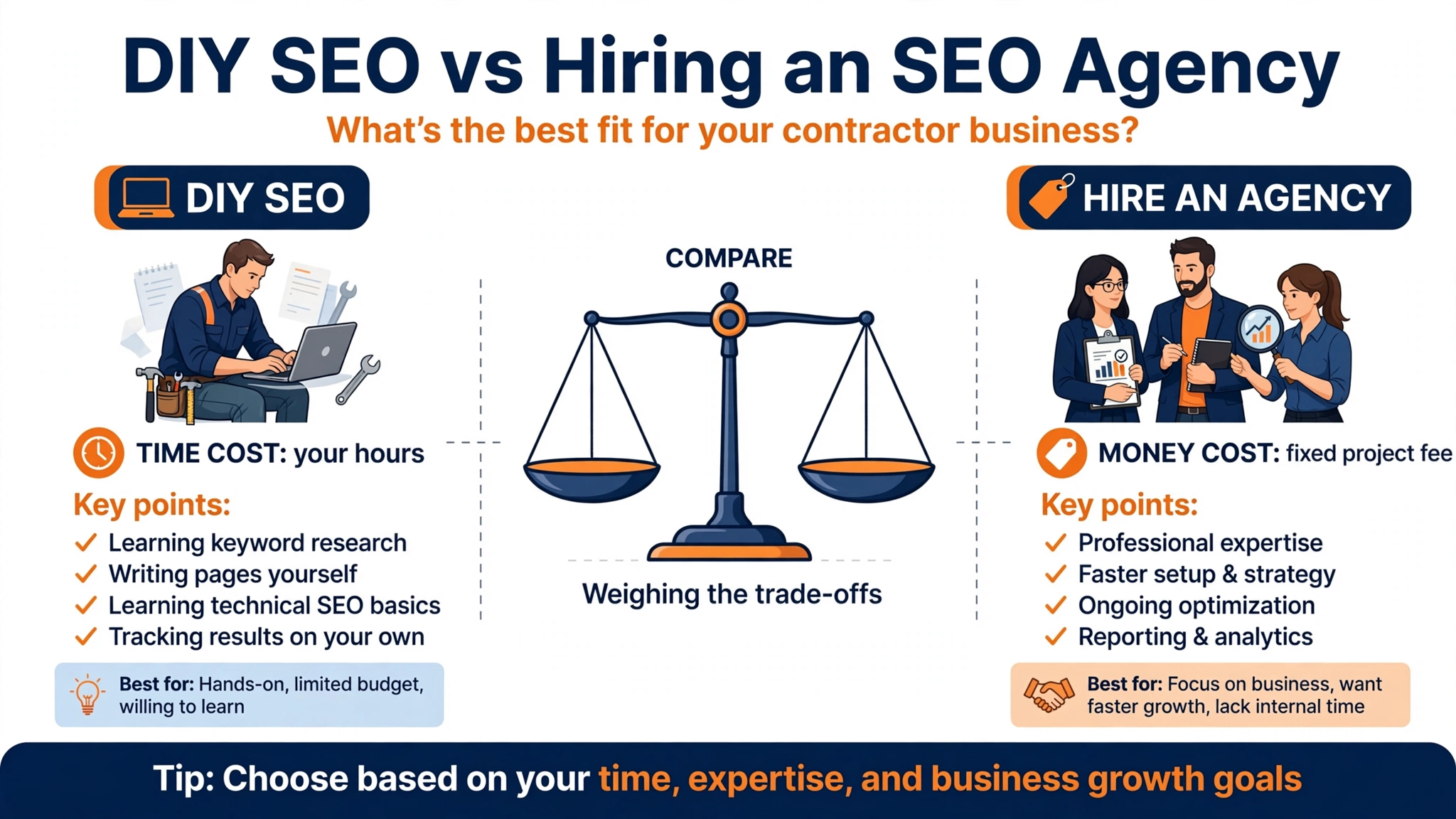
- Keyword research. Finding the exact phrases homeowners in your towns type: "roof replacement dallas," "emergency plumber austin." Free tools cover this: Google's own Keyword Planner, Google Search Console once the site is live, and the "people also ask" box on Google itself.
- Service and town pages. One page per service, one page per town you serve, each answering the homeowner's actual questions. This is writing work, and it is most of the job.
- Google Business Profile. Claimed, complete, correct categories, real photos of real jobs, and a system for asking every happy customer for a review.
- Technical basics. A fast site, working on phones, no broken pages, secure (https), and submitted to Google Search Console.
- Reviews, ongoing. The single highest-leverage recurring task. Ten minutes after each finished job, asking for the review.
- Local citations. Your business name, address, and phone number consistent across the main directories.
None of this requires a degree. All of it requires hours, every week, for months.
What DIY SEO costs
In money, DIY SEO can cost almost nothing. Google Business Profile is free. Search Console is free. Keyword Planner is free. A decent website runs a few hundred dollars a year to host. The real cost is your time: learning the basics takes a focused weekend, and the ongoing work runs several hours a week for the first six months if you are building pages and chasing reviews yourself.
Price your own hour honestly. If a finished roofing job nets you several hundred dollars and takes half a day, an hour of your time is worth real money. Ten hours a month on SEO is ten hours not spent on estimates, jobs, or rest. For an owner-operator with more time than marketing budget, that trade is often correct. For a company with crews to keep busy, it usually is not.
When DIY SEO is the right call
- You are under $500K in revenue. Marketing budgets are thin and your time is the available resource. The fundamentals (profile, reviews, town pages) are very learnable.
- You serve a small number of towns. Fewer pages to write, less competition to beat, faster results.
- You enjoy writing and systems. The people who succeed at DIY SEO are the ones who actually publish the pages and actually ask for the reviews, every week.
- Your market is not very competitive. In a small town, a complete profile plus a dozen good pages can rank. In a big metro, you are up against companies spending five figures a month.
When hiring beats DIY
- Your time books jobs. If ten SEO hours a month cost you two booked jobs, the agency is cheaper than free.
- You are in a competitive metro. Ranking "plumber dallas" against companies with full-time marketing staff is a different sport than ranking in a town of 20,000.
- You need it done in months, not learned over a year. An agency or project team starts with the patterns already learned.
- You have tried DIY for six months and stalled. Common stall points: the site itself is too slow or thin to rank, or nobody is actually publishing. Both are fixable, but not by more reading.
- You want one accountable party. Some owners would rather pay for a result than manage another weekly system themselves.
The middle option nobody talks about
It is not DIY or full agency. The most cost-effective setup for many contractors is a hybrid: pay once for the technical foundation and the page structure done right, then handle the ongoing parts yourself. The foundation (site speed, page architecture, profile setup, initial town pages) is the part where expertise matters most and mistakes cost the most. The ongoing part (asking for reviews, adding job photos, publishing one page a month) is the part an owner can do in an hour a week.
That is exactly how our contractor SEO program is built: a one-time fixed-price project starting at $799, no monthly retainer, and you own everything. We do the part where expertise matters; you keep the part you can run yourself.
Red flags when hiring an SEO agency
- Guaranteed rankings. Google does not sell positions. Anyone guaranteeing them is lying about something.
- No access to your own assets. Your website, your Google Business Profile, your ad accounts stay in your name. Always.
- Reports full of rankings, empty of calls. Rankings are a means. Booked jobs are the end.
- Secret tactics. Real SEO is boring and explainable: pages, speed, reviews, links from real local sources.
- Long contracts with no exit. Month-to-month or a clear exit clause, especially at the start.
Red flags in your own DIY plan
- Three months with no published pages. Reading about SEO is not SEO.
- Keyword stuffing and spammy tricks. They stopped working years ago and can get the site penalized.
- Buying backlinks from link sellers. Against Google's guidelines, and the links are usually worthless anyway.
- No review system. If finished jobs are not producing reviews, the highest-leverage task is not done.
Our verdict
DIY your SEO if you have more time than budget, serve a few towns, and will actually do the weekly work. Hire if your hours book jobs, your market is competitive, or you have stalled for six months. And consider the middle: pay once for the foundation done right, run the ongoing system yourself. Whichever you choose, the website has to be worth ranking first. Our pricing page shows the fixed one-time costs with nothing hidden.