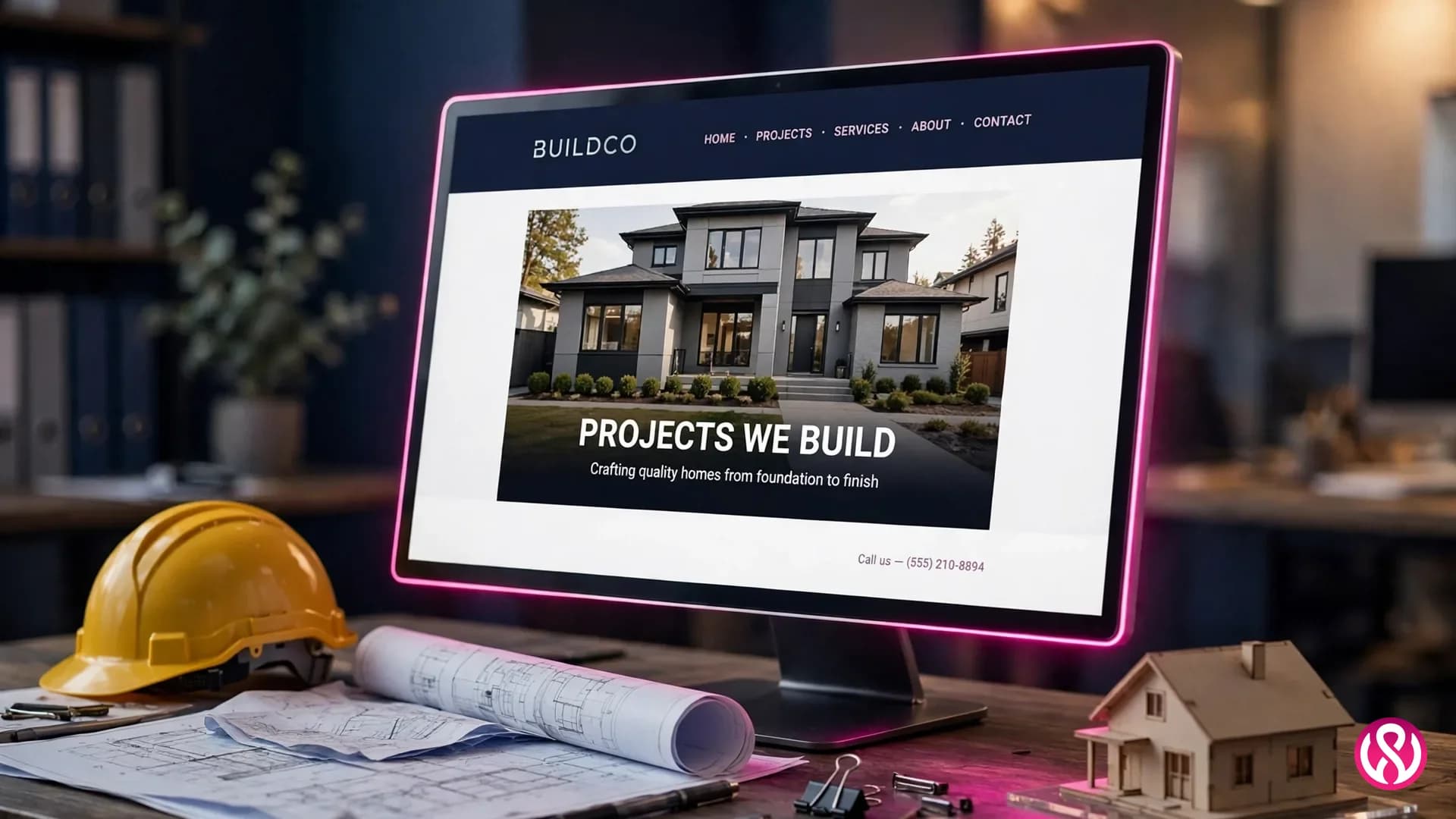
Construction website design services are custom websites built to turn construction searches into estimate requests and bid invitations: kitchen remodel quotes at 9pm, commercial tenant build-outs, service pages for each trade, and project galleries that prove the quality of the work. They differ from generic web design in the conversion anatomy. A portfolio that keeps growing, a quote form with real project intake fields, a page for each service and each town, license and insurance stated in plain sight, and reviews on the page, not just on Google.
We have designed and built websites for contractors and trade businesses since 2015, including a rebuild for M8owes Construction, a Perth builder whose organic traffic rose 200%, and Hunter Premium Skylights, a trades installer whose organic traffic rose 80% and inquiries rose 55%. What follows is the honest buyer guide: what these services actually include, what they cost in 2026 across every buying model, when each model is the right buy, and the questions that expose a bad provider before you sign.
What Are Construction Website Design Services?
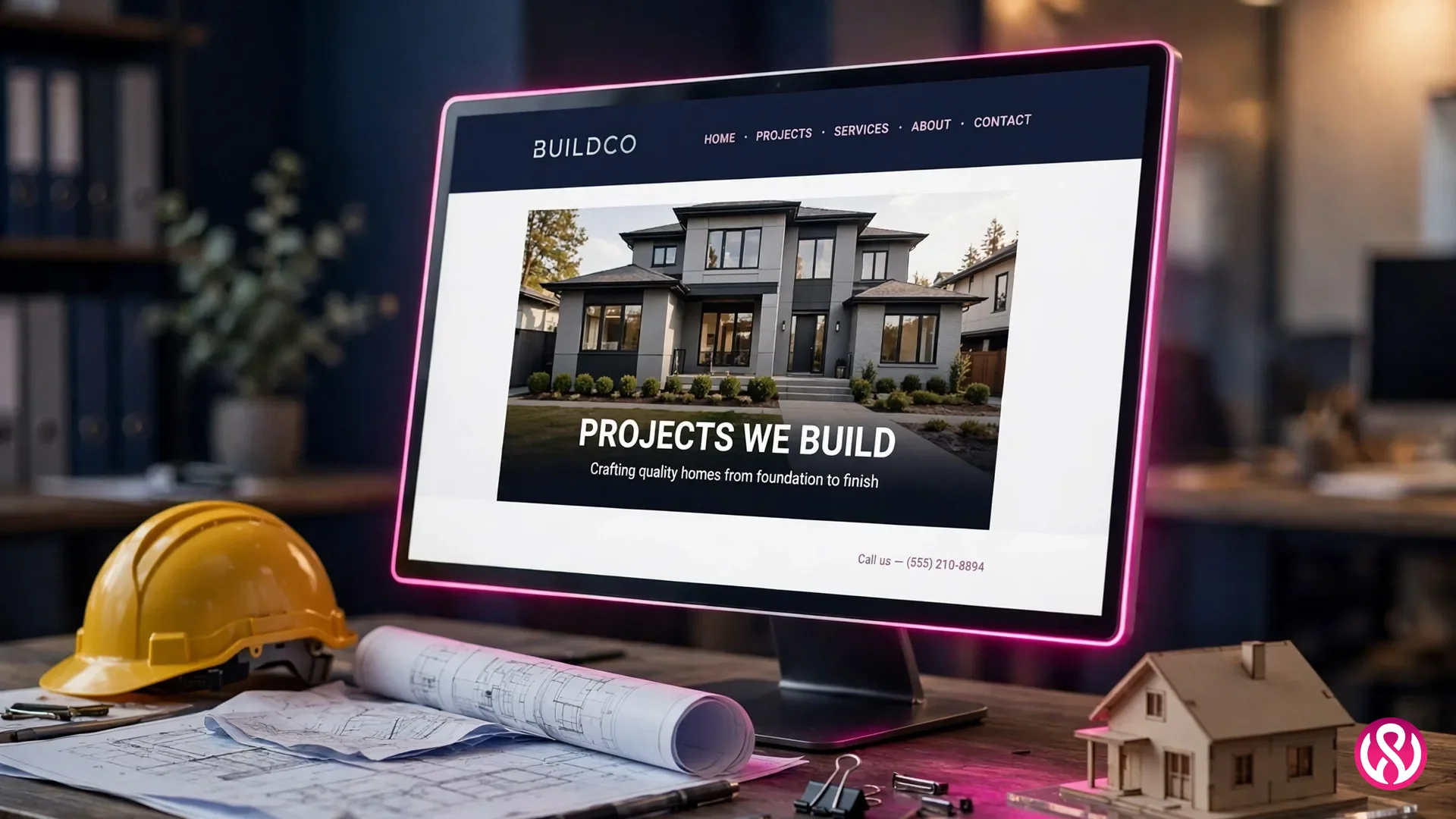
Construction website design services are the package of design, development, content structure, and search setup that agencies and freelancers sell to construction companies, general contractors, and trade contractors. The honest ones sell a lead system, not a brochure. The site's job is to make a homeowner or a developer trust the company enough to send a quote request or a bid invitation, and every service worth buying is organized around that one job.
What separates construction website design services from generic web design is the proof. A law firm site sells expertise with words. A construction site sells it with evidence: photos of completed work sorted by job type and town, project scope written in plain language, licence numbers a homeowner can check, and reviews tied to the exact service the visitor is reading about. An agency that does not ask for your project photos on the first call does not understand the trade.
The sellers fall into four groups, and each sells a different thing: DIY builders that hand you templates, freelancers who customize those templates, specialist retainers that bundle the site with ongoing marketing, and agencies that build a custom site you own outright. We cover all four later in this guide, because the price comparison only makes sense once you see what each model really sells. Our own construction website design page carries the commercial pitch for our build; this guide is the buyer education that surrounds it.
What Does a Construction Website Actually Have to Do?
A construction website has one job, and it is not looking impressive in a portfolio. It has to convert a visitor who is comparing three contractors into an estimate request or a bid invitation. That job breaks down into a short list of things the site must do, and every one of them is measurable.
It must load before the visitor gives up. A homeowner choosing a remodel contractor has four tabs open, and if your page has not rendered while the other three have, you are out before anyone read a word of it. We hold our builds to the Core Web Vitals thresholds Google publishes: largest contentful paint under 2.5 seconds, interaction to next paint under 200 milliseconds, cumulative layout shift under 0.1. Those are the same thresholds we use on every build, and they are worth demanding in writing from any provider.
It must say what you build and where. Full-service construction tells a homeowner nothing. Kitchen and bath remodels in Dallas, design-build commercial in the metro, tells them everything, and it tells a search engine everything. That means a real page per service and a real page per service area, each saying something that could only be true of that trade and that town. One page listing ten towns ranks for none of them.
It must carry trust on the page, not just on Google. People who found you through the map pack have already seen your star rating. What moves them is reading two reviews about the exact job they need done, next to your licence number, insurance statement, and photos of your actual crew and trucks. A stock photo of a model job site does the opposite: it tells an experienced homeowner the company is hiding something.
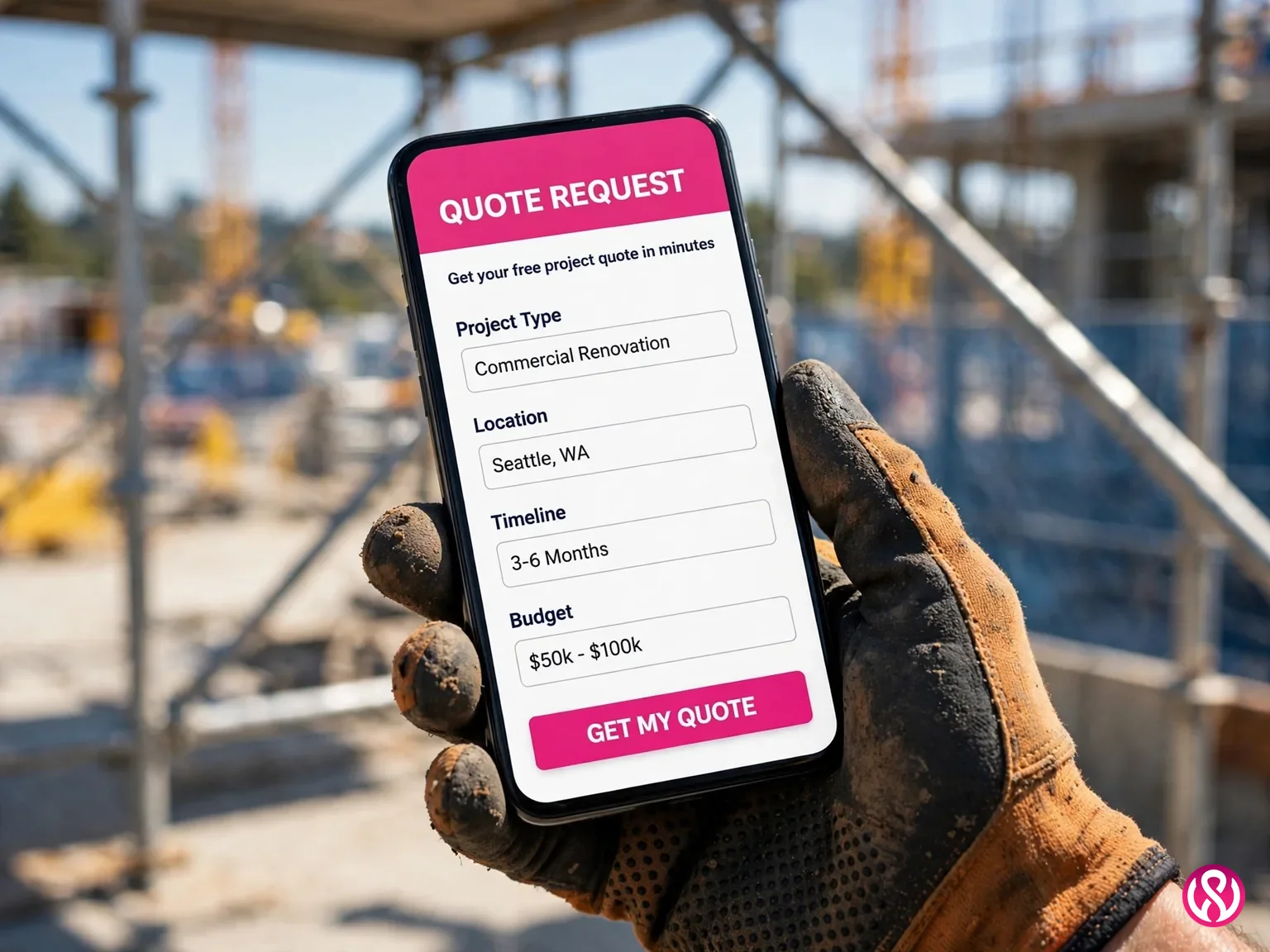
It must offer a quote path that does not require a phone call. Some visitors will call. Some will send a request at 9pm after the kids are asleep, and they will choose the contractor whose form asks the right questions: project type, location, timeline, budget range, and a place to attach photos or plans. A generic contact form that captures only a name and a phone number forces the estimator to chase every detail, and every back-and-forth loses jobs. A tap-to-call button on every screen, beside the intake form, covers both groups: the caller and the 9pm form-filler.
And it must track every lead to its source. If you cannot tell which page produced your last estimate request, you cannot tell whether the site is working. Form tracking, call tracking, and analytics should go in before launch, not after, so in month two someone can tell you which pages produced leads and where they came from. Two in five contractors cannot answer that question about their own site. Demand to be in the three in five that can.
What Should a Construction Website Include?
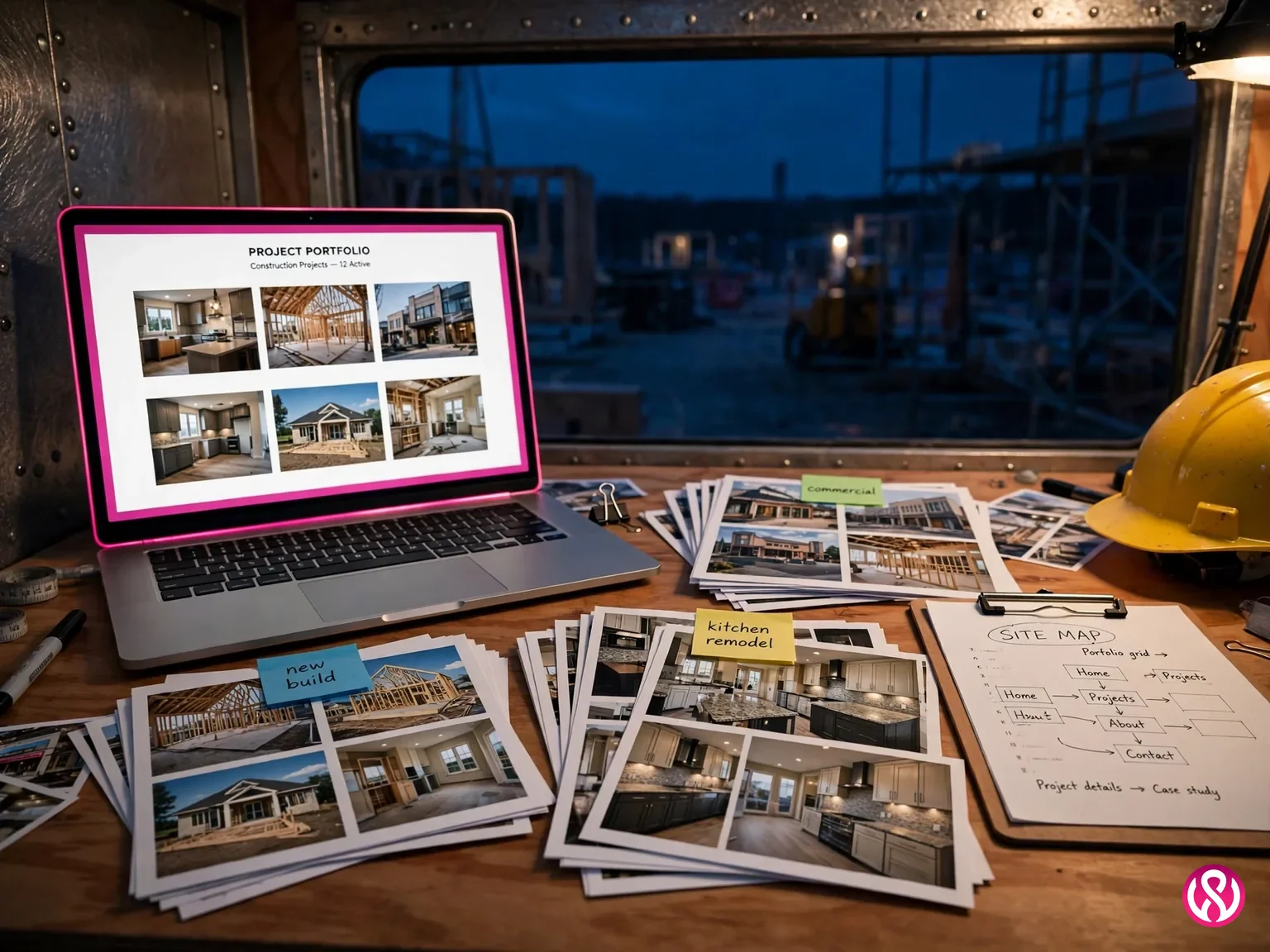
Ask this on any ranking agency page and the answers converge on the same list. A construction company website needs seven core pages, and two extras that pay off for bigger jobs. Here is the list, with what each page must carry.
Home. One promise, one strong project photo, your phone number, and the quote button. Nothing else above the fold.
Services. One page per service you sell, not a bullet list. Kitchen remodels, additions, new construction, roofing, commercial build-outs, whatever you actually sell. Each page written to rank for its own searches, with the area you cover and a quote form on the page.
Projects. Photos, location, scope, timeline, and before-and-after pairs where you have them. The before photo is what the homeowner is living with right now, and it sells harder than the polished final shot. Sort by job type and town, and write a line about each job, because a gallery of unexplained photos says nothing a search engine can rank.
About. Year founded, licences, insurance, the team, and the actual crew. This page exists so a visitor can verify you are a real company before sending a five-figure request.
Reviews. Named client quotes and ratings pulled onto the pages they belong to, with review schema so the stars can show in search results.
Get a quote. A short form: job type, location, budget range, timing, photos or plans. Three to five fields on a phone, tracked to the page it came from, landing with an alert so nobody waits.
Contact. Phone, email, office address, map, opening hours, and a Google Business Profile link that matches the phone number on the site exactly. A mismatch costs map rankings.
The two extras: an FAQ page that answers questions about cost, permits, and timelines, and a project timeline that shows clients each stage from permit to handover. Add a careers page if you are hiring, because the best hires in construction come from the company website more often than from job boards. Our guide to contractor website design cost breaks down how page count moves the budget at each tier.
The Four Ways to Buy a Construction Website
Every provider of construction website design services sells one of four models. They differ in who owns the site, how you pay, and what happens when you want to leave. Learn the models first; the price comparison only makes sense once you see what each one really sells.
1. The DIY builder: fast, cheap, and yours to run
AI builders sell construction company websites you assemble from a single description: describe the company and the builder drafts the layout, copy, and images, and the first full draft can arrive in a day or two. The price is low, around $200 to $500 a year, and there is no waiting on an agency. The trade-off is depth and honesty of proof. A builder gives you a finished page, not a conversion strategy: the same template as every other company in your county, with your brand applied as a thin skin. No call tracking wired to revenue, no service-area page structure planned around your towns, no one to call when the site stops converting. It is the right buy for a new company that needs to look legitimate this week and can live with generic.
2. The freelancer: mid-range price, quality varies
Freelancers commonly charge around $1,000 to $5,000 for a construction site, per Qrolic's 2026 market guide, with regional guides placing small-business freelancer builds between $500 and $3,000. In the contractor website design market the freelancer tier has the widest quality spread. A $1,500 site and a $4,500 site may both be called professional, but their design, page scope, content, and post-launch support can be very different. Ask to see sites built for other construction companies, and ask who owns the site, the domain, and the logins when the project ends. The good ones show you; the bad ones change the subject.
3. The specialist retainer: the trade knows the trade
Contractor-specialist agencies sell website design bundled with marketing: the build plus Google Business Profile work, review automation, and a CRM login so missed calls get a text back. Published contractor retainer plans sit around $197 to $497 a month all-in. The strength is specialization. Every page is built around estimate requests, and the reporting ties calls to revenue. The trade-off is ownership timing and the monthly line item that never ends. Read the exit terms before you sign: some plans keep the site with the agency if you leave early. An agency that hesitates on ownership is building a hostage site.
4. The agency fixed build: you own it, they build it right
This is the traditional model and the one we sell. An agency designs and builds a custom website you own outright, with the construction conversion anatomy built in from the first wireframe: project portfolio structure, service and area pages, schema, speed work, and local SEO. Per Qrolic's 2026 guide, professional custom builds for construction companies run $3,000 to $8,000 and up, while larger multi-location builds move into five figures. Our own builds start at $799 for a Starter site, $1,499 for the Professional build most construction companies choose, and $2,499 and up for enterprise scope, every project fixed and itemised in writing before work starts. The site, the domain, and the hosting account are registered in your name from day one. The strength is continuity and ownership: the team that built the site knows the code, and nobody can hold it hostage. The weakness is the upfront cost, which is real money for a small shop. That is why the quote should be fixed and itemised before you pay a deposit, never hourly and never open-ended.
What Construction Website Design Costs in 2026
The honest answer is a table, not a number, because construction website cost is driven by scope, not just the figure on the quote. Qrolic's 2026 construction cost guide, which cites GoodFirms' 2026 agency survey finding fixed-price projects ranging from about $1,000 to $150,000 with 63% between $1,000 and $15,000, gives the clearest published bands in this niche. Here they are, with the best fit for each. The construction website cost question always comes back to the same point: scope drives the number, not the other way around.
DIY website builder: around $200 to $500 a year. Best for solo operators and very early-stage businesses that need a simple presence and will manage the site themselves.
Template or freelancer build: around $1,000 to $5,000. Best for small contractors with straightforward needs who want something more professional without a full agency project.
Professional custom build: around $3,000 to $8,000 and up. Best for small-to-mid construction companies that need the site to generate enquiries consistently. If lead generation is the point, this is the tier to investigate first.
Full agency or multi-location build: around $10,000 to $30,000 and up. Best for larger firms with multiple locations, divisions, or complex quote and CRM integrations. Trajectory Web Design's 2026 pricing guide puts most construction builds between $15,000 and $50,000, noting that proof, project galleries, capability statements, and real photography, carries much of the budget because it is what owners and developers actually evaluate.
Then there is the ongoing side, which quotes routinely omit. Per the Qrolic guide: domain $10 to $20 a year, hosting $5 to $75 a month, maintenance $50 to $500 a month, and SEO as a separate monthly retainer when you compete across multiple services or locations. Our own pricing sits deliberately below the agency band: $799 Starter, $1,499 Professional, $2,499 and up for enterprise, with care plans at $99 to $399 a month and no lock-in. Whatever number you are quoted, ask what it includes: page count, service and area page structure, mobile-first build, speed work, schema, review integration, quote intake, and who maintains it after launch. A quote that excludes half of that list is not cheaper, and no construction website cost comparison means anything until the scopes match. It is smaller, and the difference arrives as a second invoice later.
Is a Cheap Construction Website Worth It?
A $500 website can be perfectly reasonable in some situations, per Qrolic's 2026 guide. The problem starts when a company expects a basic site to do the job of a lead-generation system. A low-cost website may be enough if you simply need a basic company profile, a small number of pages, contact information, a simple enquiry form, and a starting point while the business grows. That is a legitimate use case, and a new company should not pay for scope it cannot use yet.
It stops being enough when you need strong service-area coverage, multiple dedicated service pages, a detailed project portfolio, more sophisticated lead capture, custom design, a stronger SEO foundation, or integrations with other business systems. A cheap site may work exactly as designed and still be insufficient for the business's next stage, and the rebuild you buy eighteen months later costs more than buying the right scope once. The better question is never what the cheapest website is. It is what website scope your business actually needs, matched to the online quote request flow your estimators can work with. Budget against your average job value, not against the lowest quote, and treat your online presence as the asset it is.
Should You Redesign or Rebuild Your Construction Website?
Not every tired construction site needs a full rebuild. A redesign refresh is enough when the bones are good: the site is on WordPress with a clean theme, the service and area pages already exist, the portfolio is current, and the problem is stale copy, weak calls to action, or a design that looks ten years old. A refresh keeps the platform and the URL structure, and puts the budget into conversion work: rewriting the homepage around estimate requests, adding the project intake fields, and wiring review automation.
A rebuild is the right call when the platform is the problem. Sites built on heavy page builders or proprietary platforms that lock your content in are the usual suspects: every page carries markup that slows it down, and nobody can update anything safely. A site over six years old that was never built for mobile is another rebuild case, as is a company that has outgrown its service area pages and needs a new structure planned around the towns that actually pay. The rebuild should preserve your existing search rankings with proper redirect mapping before anything moves, because a casual migration is how a company loses the rankings it spent years earning. Our contractor website mistakes guide lists the structural errors we see most often in rebuild audits.
The deciding test is simple. If your customers can find the site but it does not convert, refresh the design and the copy. If your customers cannot find it at all, that is a local SEO problem, and an honest agency will say so on the first call rather than after you have paid for a rebuild. And if the platform fights every change you try to make, rebuild on something your team can run. A WordPress company site on the block editor with clean templates is the default we recommend, because your staff can add a finished project in minutes and any competent developer can take it over. A portfolio that freezes at launch is worthless; the whole value of a construction portfolio is recency, and if adding a completed job requires a developer, it stops happening within three months.
How Long Does a Construction Website Take to Build?
Most custom construction websites take 8 to 12 weeks from kickoff to launch, depending on the number of pages, the amount of content and photography needed, and how many rounds of revisions are involved. That figure comes from TheeDigital's published construction web design page, and it matches what we see across the industry. Our own builds run 2 to 8 weeks from the signed quote, because we start with a fixed scope agreed in writing rather than discovering it mid-project.
What actually moves the timeline is content, not code. Project photos and written scope notes arrive late in nine builds out of ten, and every round of photography you promise to send next week is a week the launch slips. The fastest projects hand the provider real photos, licence details, and the service list on day one. Agree the content deadline in the contract next to the launch date, and hold yourself to the same deadline you hold the agency to.
Nine Checks Before You Sign
Run any proposal from a construction web design company through these nine before you pay. They come from the published market guides above and from the anatomy that every ranking agency page converges on.
1. Who owns the site? The domain, the hosting account, the site files, and the content should be in your name from day one. An agency that hesitates on this is building a hostage site, and the exit terms are where providers genuinely differ.
2. Real project photos or stock? Ask to see how the portfolio will look with your photos, not the demo photos. A site populated with stock construction imagery tells every experienced visitor the company has nothing to show.
3. Can you add a finished project in minutes? The portfolio only works if it keeps growing. If adding a completed job requires a developer, it stops happening within three months. Ask for the workflow in writing.
4. Licence, bond, and insurance in plain sight? Your licence number, bond, and insurance should be stated where a visitor looks before calling: the header, the footer, and beside every form. A general contractor vetting you as a subcontractor finds the same details without having to ask.
5. Are bids and estimates kept apart? A free estimate for a homeowner and an invitation to bid from a builder are two different conversations, with different intake fields and different due dates. Each deserves its own form, so the estimator knows which conversation they are walking into before they dial.
6. Is the service-area structure planned? One page listing ten towns ranks for none of them. The proposal should name the towns and show how each gets a real page written from your job history there.
7. Does it track calls to pages? Form tracking and call tracking should go in before launch, so in month two someone can tell you which pages produced leads and where they came from.
8. What does month two cost? Hosting, security updates, backups, and content edits are real ongoing work. Most contractor website design proposals bury this number on purpose. Get the monthly figure, the response time, and the exit terms in writing before you sign, because that is where agencies genuinely differ.
9. Can your team update it without code? Your staff should be able to add a project, update the service list, and post a seasonal special without calling a developer. Ask for the handover training in writing, because a site your team cannot touch becomes a monthly invoice for every small change.
Residential vs Commercial: The Website Split
A construction website design service should ask which half of the market you serve before it plans a single page, because residential and commercial buyers use the site differently. Residential sites sell to homeowners: before-and-after photos, financing mentions, reviews about the exact job, and a quote form built for people, not for bid packages. Our home services website design guide covers this half of the market in full.
Commercial sites sell to developers, owners, and general contractors, and they read more like a capability statement. Sector pages for office, retail, industrial, healthcare, and education work. Delivery methods stated plainly: design-build, construction management, general contracting. Safety and bonding information, prequalification packages, a bid invitation inbox with due dates and addenda tracking, and subcontractor registration, so a bid team can qualify the firm in one visit. A commercial portfolio shows budget and schedule outcomes where the firm shares them, and progress photo sequences, because prospective clients are persuaded by seeing how a project went, not just the finished photograph. If a provider pitches you the residential anatomy when you chase commercial work, they are selling the wrong site.
Why Construction Companies Pick Websloop
We are not a construction-only agency, and we will not pretend to be one. What we are is a contractor-trade builder with measured results. M8owes Construction, a Perth builder, saw organic traffic rise 200% after a three-week rebuild. Hunter Premium Skylights, a trades installer, saw organic traffic rise 80% and inquiries rise 55%. OurHVAC website design services guide shows the same buyer-guide method applied to the heating and cooling trade. That is the kind of result a construction company is looking for, measured the same way. If you are comparing construction website design services side by side, that is the number to ask every provider for: a measured before and after, not a promise.
Every build follows the same rules. Fixed price, quoted in writing before work starts, half on start and half on launch. No hourly billing. You own the domain, the code, the content, and every login from day one. Technical SEO, schema, and Core Web Vitals work are in the quote, not a second project. And the construction website design industry page carries the full commercial offer, while our services page maps the rest of what we build.
The Verdict
Construction website design services earn their cost when the site does eight things: loads fast on a phone, says what you build and where, shows real project photos with real scope, states licence and insurance in plain sight, offers a quote path that asks the right questions, keeps bids and homeowner estimates apart, tracks every lead to its page, and stays updated by your own team after launch. Buy the DIY builder for speed and low cost if you can live with generic. Buy the freelancer when a trusted one shows you construction sites they built. Buy the specialist retainer when you want the whole marketing machine and can read the exit terms. Buy the fixed agency build when you want to own a custom asset outright. Whatever you choose, get ownership, inclusions, response times, and exit terms in writing before you pay. And when a construction web design company refuses to name its monthly number in writing, take that as the answer to check eight.
If you want a fixed quote for your own project, start with our free quote. It includes a free 30-minute consultation where we scope the design honestly, and we will tell you plainly if a rebuild is not the right buy for you.