HVAC website design services are custom websites built to turn heating and cooling searches into booked jobs: emergency repair calls at 11pm, installation quotes, maintenance plan signups. They differ from generic web design in the conversion anatomy. A tap-to-call button on every screen, a page for each service and each town, reviews on the page, and online booking for homeowners who will not pick up the phone.
We have designed and built websites for trades businesses since 2015, including a rebuild for Hunter Premium Skylights, a trades installer whose organic traffic rose 80% and inquiries rose 55%. What follows is the honest buyer guide: what these services actually include, what they cost in 2026 across every buying model, when each model is the right buy, and the questions that expose a bad provider before you sign.
What Does an HVAC Website Actually Have to Do?
An HVAC website has one job, and it is not looking pretty in a portfolio. It has to convert a stressed homeowner into a booked job. That job breaks down into a short list of things the site must do, and every one of them is measurable.
It must load before the visitor gives up. A homeowner with a dead furnace has three tabs open, and if your page has not rendered while the other two have, you are out before anyone read a word of it. We hold our builds to the Core Web Vitals thresholds Google publishes: largest contentful paint under 2.5 seconds, interaction to next paint under 200 milliseconds, cumulative layout shift under 0.1.
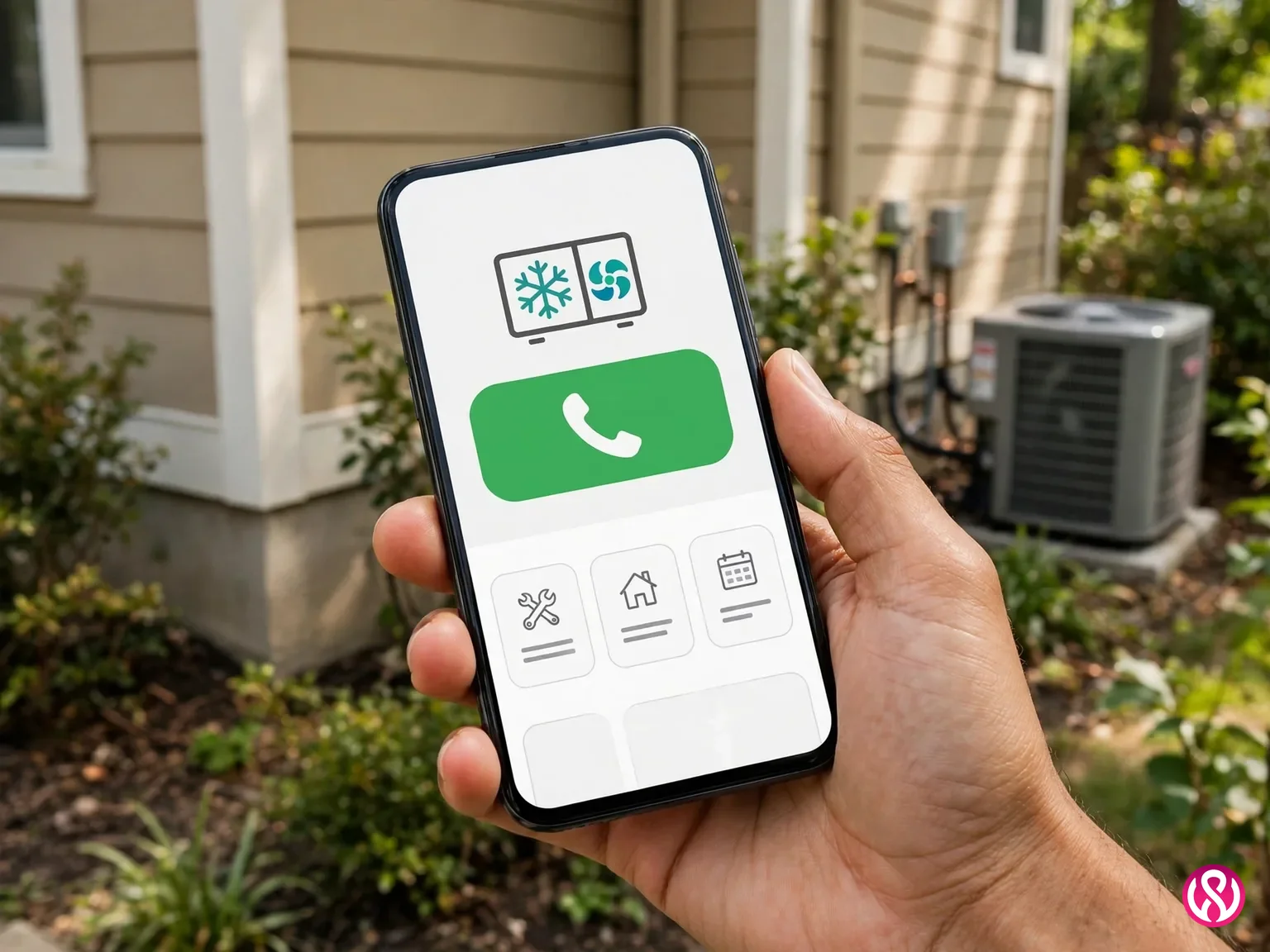
Calling must take one tap. The number should be tappable, visible without scrolling, on every page, and it must match the Google Business Profile exactly. A mismatch costs map pack rankings, which is where most emergency calls come from.
It must say what you fix and where. Comfort solutions for your home tells a homeowner nothing. Emergency AC repair in Fort Myers, same day, seven days a week tells them everything, and it tells a search engine everything. That means a real page per service and a real page per service area, each saying something that could only be true of that town. One page listing eight towns ranks for none of them.
It must carry trust on the page, not just on Google. People who found you through the map pack have already seen your star rating. What moves them is reading two reviews about the exact job they need doing, next to licence and insurance badges and photos of your actual crew and trucks.
And it must offer booking that does not require a phone call. Some homeowners will call. Some want to book a repair at 11pm without talking to anyone. A quote form that texts and emails you within seconds, or a real online booking calendar, captures the second group. Every extra tap between a customer and a booking is a share of them lost.
What 1,306 HVAC Websites Reveal About the Bar
In October 2026, Honest HVAC Marketing published an audit of 1,306 HVAC contractor homepages across major US metro areas, loaded on a 390-pixel phone screen. It is the most useful public dataset in this niche, and it sets the bar your site has to clear. The median score was 62 out of 100, and one in five sites scored under 40. In other words, the average HVAC website is a D-minus, and most of your competitors are failing the basics.
The individual checks are where the buying insight lives. 86% of homepages had a tap-to-call link, but only 42.5% kept a call button on screen as you scroll. 72% named their service area on the homepage and 65% said they offer 24/7 or emergency service, while roughly one in four did not name an area at all. Only 28% showed a star rating with a review count on the homepage, though 57% showed testimonials. 39% of sites offered a phone call as the only way to get in touch: 513 sites had no form, booking, or chat. Only 19% had real online-booking software. 20% showed real photos of the crew, trucks, or work. And 41% had no analytics or ad tracking the auditors could detect, which means two in five contractors cannot tell you which page produced their last lead.
Read it as a buyer and the message is plain. The bar is low, and a site that simply does the fundamentals, tap-to-call everywhere, real pages per service and town, reviews on the page, booking without a phone call, speed on a real phone, and tracking from day one, already beats four out of five competitors. When an agency pitches you, ask how many of those seven it includes in the quote. That is the question most of them cannot answer.
The Three Ways to Buy an HVAC Website
Every HVAC website on the market is one of three models. They differ in who owns the site, how you pay, and what happens when you want to leave. Learn the models first; the price comparison only makes sense once you see what each one really sells.
1. The DIY builder: fast, cheap, and yours to run
Builders like Zarla sell HVAC websites you assemble in minutes: pick the trade and the town, and the builder writes the content and ships the site, sometimes in under a minute. The price is low and there is no waiting on an agency. The trade-off is depth. A builder gives you a finished page, not a conversion strategy: no call tracking wired to revenue, no service-area page structure planned around your towns, no one to call when the site stops converting. It is the right buy for a one-truck shop that needs to look legitimate fast and can live with generic.
2. The HVAC specialist retainer: the trade knows the trade
Specialist agencies sell HVAC website design bundled with marketing: the build plus Google Business Profile work, review automation, and a CRM login so missed calls get a text back. Honest HVAC Marketing publishes its plans openly: $995, $1,995, or $2,995 for the build plus $197, $347, or $497 a month, with the site and CRM moving into your name after 12 months. The strength is specialization. Every page is built around booked jobs, and the reporting ties calls to revenue. The trade-off is ownership timing and the monthly line item that never ends. Read the exit terms before you sign: some plans keep the site with the agency if you leave early.
3. The agency fixed build: you own it, they build it right
This is the traditional model and the one we sell. An agency designs and builds a custom website you own outright, with the HVAC conversion anatomy built in from the first wireframe: tap-to-call, service and area pages, schema, speed work, and local SEO. Our own builds start at $799 for a Starter site, with fixed quotes agreed before work begins, and care plans at $99 to $399 a month if you want the upkeep handled. The site, the domain, and the hosting account are registered in your name from day one. The strength is continuity and ownership: the team that built the site knows the code, and nobody can hold it hostage. The weakness is the upfront cost, which is real money for a small shop. That is why the quote should be fixed and itemized before you pay a deposit.
What HVAC Website Design Costs in 2026
Agency builds in this space commonly run $4,500 to $14,000 up front, or a monthly retainer from around $800, per Honest HVAC Marketing's published market read. The DIY end starts near free. Our own pricing sits deliberately below the agency band: $799 for a Starter site, $1,499 for the professional build most trades businesses choose, and $2,499 and up for enterprise scope, every project fixed and itemised in writing before work starts.
Price alone never tells the story. Qrolic, which publishes an HVAC design and development process, notes that cost varies with the number of service pages, custom features, and local SEO requirements, and quotes after an initial assessment. Whatever number you are quoted, ask what it includes: the page count, the service and area page structure, mobile-first build, speed work, schema, review integration, booking, and who maintains it after launch. A quote that excludes half of that list is not cheaper. It is smaller, and the difference arrives as a second invoice later.

Should You Redesign or Rebuild Your HVAC Website?
Not every tired HVAC site needs a full rebuild. A redesign refresh is enough when the bones are good: the site is on WordPress with a clean theme, the service and area pages already exist, and the problem is stale copy, weak calls to action, or a design that looks ten years old. A refresh keeps the platform and the URL structure, and puts the budget into conversion work: rewriting the homepage for booked jobs, adding the sticky call button, and wiring review automation.
A rebuild is the right call when the platform is the problem. Sites built on heavy page builders or proprietary platforms that lock your content in are the usual suspects: every page carries markup that slows it down, and nobody can update anything safely. A site over six years old that was never built for mobile is another rebuild case, as is a company that has outgrown its service area pages and needs a new structure planned around the towns that actually pay. The rebuild should preserve your existing search rankings with proper redirect mapping before anything moves, because a casual migration is how a company loses the rankings it spent years earning.
The deciding test is simple. If your customers can find the site but it does not convert, refresh the design and the copy. If your customers cannot find it at all, that is a local SEO problem, and an honest agency will say so on the first call rather than after you have paid for a rebuild. And if the platform fights every change you try to make, rebuild on something your team can run. A WordPress company site on the block editor with clean templates is the default we recommend, because your staff can update it and any competent developer can take it over. Squarespace suits a simple brochure site for a one-truck company that will never need custom features, but it stops being the right platform the moment you need real booking integrations, custom service-area structures, or call tracking wired to revenue.
Seven Checks Before You Sign
Run any proposal through these seven before you pay. They come from the audit data above and from the questions HVAC contractors actually ask on ranking agency pages.
1. Who owns the site? The domain, the hosting account, the site files, and the content should be in your name from day one. An agency that hesitates on this is building a hostage site.
2. Is it mobile-first for real? More than half your visitors are on phones, and emergency searches happen in driveways. Ask to see a build load on a real phone on a real connection, not on the designer's laptop on office wifi.
3. Does it track calls to pages? 41% of audited HVAC sites had no detectable analytics. Form tracking and call tracking should go in before launch, so in month two someone can tell you which pages produced leads and where they came from.
4. Is local SEO part of the build? NAP consistency, geo-targeted content, and schema markup for service areas should be in the quote, not sold as a separate project after launch.
5. Can you update it yourself? Your team should be able to update the service list, add staff bios, and post seasonal specials without writing code or calling a developer. Ask for the handover training in writing.
6. Does it generate reviews automatically? Review requests by text or email after every job are the cheapest marketing an HVAC site can do. If the proposal has no review system, you are leaving the strongest trust signal on the table.
7. What does month two cost? Hosting, security updates, backups, and content edits are real ongoing work. Get the monthly number, the response time, and the exit terms in writing before you sign, because that is where agencies genuinely differ.
Why HVAC Contractors Pick Websloop
We are not an HVAC-only agency, and we will not pretend to be one. What we are is a contractor-trade specialist with measured results. Hunter Premium Skylights, a trades installer, saw organic traffic rise 80% and inquiries rise 55% after a three-week rebuild: the kind of result an HVAC contractor is looking for. Our HVAC website design service page carries the full commercial pitch, and our HVAC marketing service pairs the build with the ongoing search work when the market is contested.
Every build follows the same rules. Fixed price, quoted in writing before work starts, half on start and half on launch. No hourly billing. You own the domain, the code, the content, and every login from day one. Technical SEO, schema, and Core Web Vitals work are in the quote, not a second project. And the home services website design guide covers the wider trade cluster this niche sits inside, so the whole site architecture points in one direction.

The Bottom Line
An HVAC website earns its cost when it does seven things: loads fast on a phone, keeps the phone number one tap away, names the service and the town, shows reviews and real photos, offers booking without a call, tracks every lead to its page, and stays maintained after launch. Most of the 1,306 sites audited in 2026 fail at least three of those. Buy the DIY builder for speed and low cost if you can live with generic. Buy the specialist retainer when you want the whole marketing machine and can read the exit terms. Buy the fixed agency build when you want to own a custom asset outright. Whatever you choose, get ownership, inclusions, response times, and exit terms in writing before you pay.
If you want a fixed quote for your own project, start with our free quote. It includes a free 30-minute consultation where we scope the design honestly, and we will tell you plainly if a rebuild is not the right buy for you.