
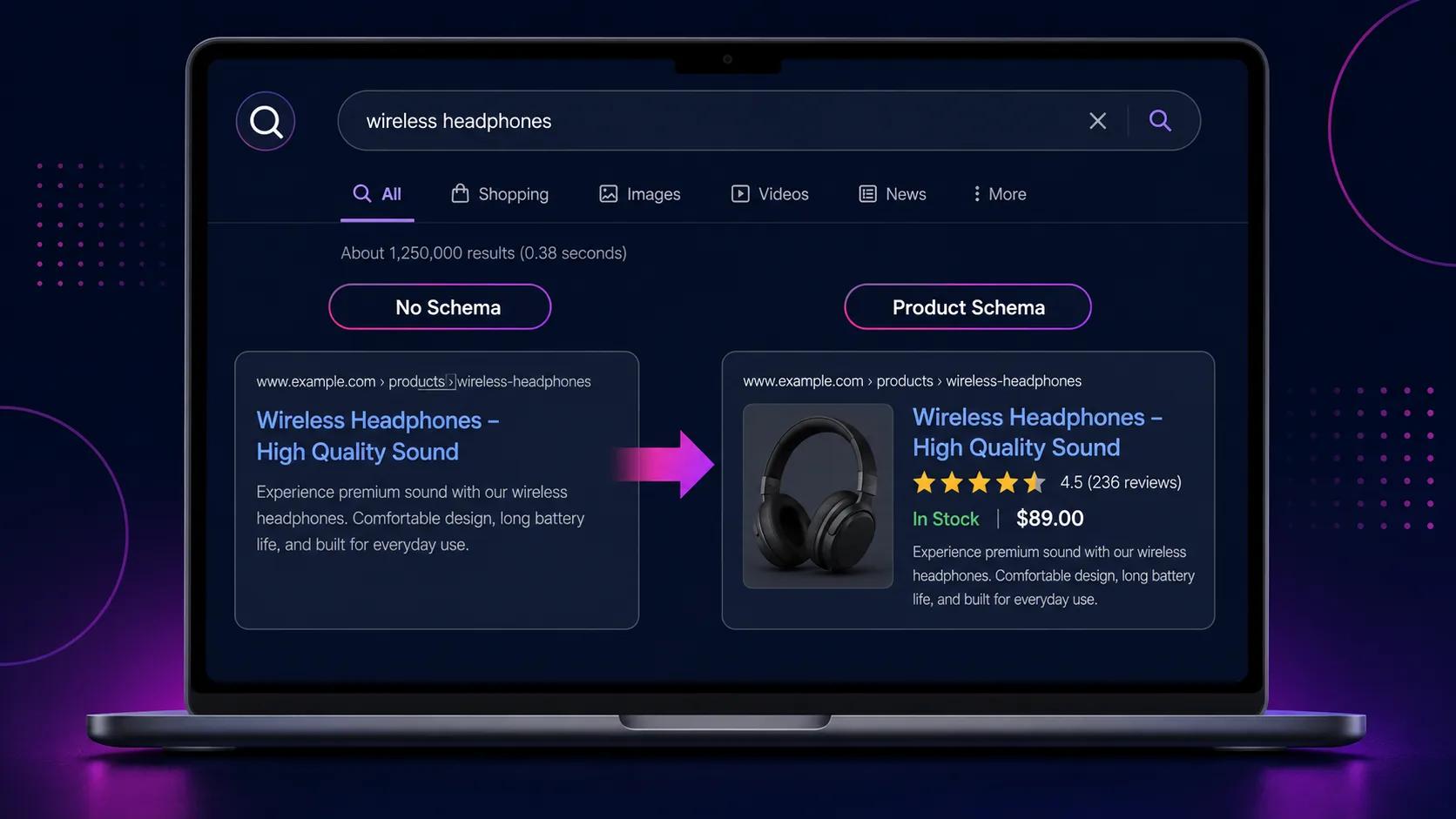
Schema markup is structured data code added to your website’s HTML that tells search engines and AI systems exactly what your content means, not just what it says. In 2026, it is also the primary signal that determines whether your content appears in Google AI Overviews, ChatGPT citations, and Perplexity recommendation panels.
Most SEO advice treats schema as a technical nice-to-have for rich results (star ratings, FAQ dropdowns, price ranges in search listings). That is still true, but it misses the more important story: schema is how you communicate with AI. In a world where 40% of searches now involve some form of AI-generated answer, structured data is the difference between being cited as a source and being invisible.
What Schema Markup Actually Does
Search engines are good at reading text. They are less reliable at understanding what that text means in context. Consider a paragraph that says “Habib Ahmed founded The Websloop in 2015.” A human reader understands immediately that Habib Ahmed is a person, The Websloop is an organization, and 2015 is the founding year.
A search engine can infer these things from surrounding context, but it cannot be certain without explicit signals. Schema markup provides those signals. A schema tag that says "@type": "Person", "name": "Habib Ahmed", "foundedOrganization": "The Websloop" makes the relationship unambiguous. No inference required. The search engine knows exactly what each entity is and how they relate.
This matters because AI systems build knowledge graphs of entities and relationships. The more clearly your content defines its entities through structured data, the more confidently AI systems can include your site as an authoritative source for queries related to those entities.
According to Stackmatix’s structured data research, 71% of pages cited by ChatGPT use schema markup. That is not a coincidence. It is how AI systems build trust in a source.
JSON-LD: The Only Schema Format Worth Using in 2026
Schema markup can be written in three formats: JSON-LD, Microdata, and RDFa. Google recommends JSON-LD, and it is the only format worth using in 2026.
JSON-LD (JavaScript Object Notation for Linked Data) is a block of code placed inside a <script type="application/ld+json"> tag, typically in the <head> section of your HTML. It does not change how your page looks to visitors. It only adds machine-readable data that search engines and AI crawlers read.
Here is what a simple Organization schema looks like in JSON-LD:
{
  "@context": "https://schema.org",
  "@type": "Organization",
  "name": "The Websloop",
  "url": "https://websloop.com",
  "email": "hello@websloop.com",
  "telephone": "+923350021022",
  "foundingDate": "2015",
  "areaServed": ["United States", "United Kingdom", "United Arab Emirates"]
}
The @context always points to schema.org, which is the shared vocabulary created and maintained by Google, Bing, Yahoo, and Yandex. The @type tells the search engine what kind of thing you are describing. Everything else is the specific properties that describe it.
The Most Important Schema Types for Businesses in 2026
Schema.org lists hundreds of types. Most are irrelevant to a typical business website. Here are the ones that actually move the needle:
Organization / LocalBusiness
Every business website should have Organization schema on the homepage and in the site-wide metadata. It establishes your entity: your name, URL, contact details, founding date, social profiles, and services offered. LocalBusiness extends Organization with geographic service area data, which is essential for businesses serving a specific city or region.
Note: ProfessionalService as a schema type was deprecated by Google in early 2026. Use LocalBusiness or plain Organization combined with Service objects for professional services businesses.
Article / BlogPosting
Every blog post and article should include Article or BlogPosting schema. The most critical fields are headline, datePublished, dateModified, author (typed as Person with a name and URL), and publisher. The dateModified field specifically signals content freshness to AI systems and is one of the factors in AI Overview source selection.
FAQPage
Google removed FAQ rich results from desktop search in May 2024 and largely from mobile in 2026. However, FAQPage schema still matters in 2026 for a different reason: it is one of the primary schema types that AI systems use to extract clean, citable question-and-answer pairs. Perplexity, ChatGPT, and Google AI Overviews all pull from structured FAQ data when answering user questions.
Do not remove FAQPage schema because the visible rich result is gone. The AI citation value is the reason to keep it.
Product
For e-commerce sites, Product schema with name, description, price, availability, and aggregateRating is essential for product rich results in Google Shopping and for AI-powered shopping recommendation features. Shopify generates this automatically for most themes. WooCommerce requires an SEO plugin like Rank Math to implement it correctly.
BreadcrumbList
Breadcrumb schema signals your site’s hierarchy to search engines. This helps Google understand which pages are most important and how content is organized. It also generates the breadcrumb trail in search listings, which improves click-through rates by showing users where a page sits in your site structure before they click.
Service
For service businesses, explicitly marking up each service with a Service schema type (including name, description, provider, areaServed, and a url to the service page) helps AI systems understand what you offer and whom you serve. This feeds into AI-generated business recommendations.
HowTo and VideoObject
HowTo schema is particularly powerful in 2026 because it maps directly to the structured answer format that AI systems prefer. If you publish how-to guides or tutorial content, implementing HowTo schema with numbered steps dramatically increases the chance of being cited in AI-generated answers to process-based queries.
Schema Types Deprecated or Changed in 2026
Stay current on schema changes or you may be implementing types that no longer generate the results you expect:
- FAQPage rich results: The visible FAQ dropdown in Google search was deprecated for desktop in May 2024 and for most mobile in 2026. The schema type itself is still valid and still valuable for AI citations, but do not implement it expecting visible FAQ dropdowns in search results.
- ProfessionalService @type: Deprecated. Use
LocalBusinessorOrganizationwithServicechildren instead. - HowTo and Recipe rich results: Currently still active, but Google has signalled reduced emphasis in favor of AI-generated summaries. Worth implementing but do not over-invest based solely on rich result expectations.
How to Add Schema Markup to WordPress
The most efficient way to add schema to WordPress is through an SEO plugin. Rank Math and Yoast SEO both generate the most critical schema types automatically:
- Rank Math adds Article/BlogPosting schema automatically on posts, Organization schema on all pages via site settings, and has a dedicated schema builder for adding custom schema types to any post or page.
- Yoast SEO generates Article, BreadcrumbList, WebPage, WebSite, and Organization schema automatically. It also has a structured data blocks feature for adding HowTo and FAQ schema through the WordPress editor.
For anything beyond what the SEO plugins cover (custom schema for specific service pages, case study schema, Person schema for team members), you can add raw JSON-LD code via a custom header script or a plugin like Insert Headers and Footers. We also generate schema programmatically in our Next.js builds using utility functions, which gives full control over every schema field on every page type. Our SEO optimization service includes a full schema audit and implementation as part of the engagement.
How to Add Schema Markup to Shopify
Shopify generates Product, Organization, BreadcrumbList, and basic WebSite schema automatically for most themes. For additional schema types, you have two options:
- Schema apps: Apps like JSON-LD for SEO or Rich Snippets & Schema add more schema types through Shopify’s app interface without requiring code edits.
- Custom Liquid templates: For full control, you can add JSON-LD blocks directly to your Shopify theme’s Liquid templates. This is the approach we use for our Shopify development clients who need precise schema implementation.
How to Test Your Schema Markup
After adding schema, always validate it before assuming it is working. Three tools cover what you need:
- Google’s Rich Results Test (search.google.com/test/rich-results): Shows which schema types Google detects on a page and whether any errors or warnings are present. Also shows which rich result types are eligible based on your schema.
- Schema.org Validator (validator.schema.org): Validates your JSON-LD syntax against the schema.org specification. Use this to catch property name errors, missing required fields, and incorrect data types.
- Google Search Console: The Enhancements section shows live data on how your schema is performing in search. If rich results are eligible but not showing, Search Console tells you why.
Schema Markup and AI Citations: What the Data Shows
The connection between schema markup and AI citation is the most important shift in structured data strategy in 2026. Here is what the data shows:
- Content with proper schema markup has a 2.5 times higher chance of appearing in AI-generated answers, according to SearchScaleAI’s 2026 schema research.
- Sites with complete Organization, Article, and FAQPage schema see up to 40% more AI Overview appearances compared to equivalent content without schema.
- 71% of pages cited by ChatGPT implement schema markup.
- For comparison content (which has a 95.4% AI Overview appearance rate in our internal data), structured comparison tables and explicit schema typing dramatically improve the citation rate further.
The mechanism is straightforward. AI systems prefer sources they can interpret with confidence. Schema removes ambiguity about what entities your content discusses, what questions it answers, and what claims it makes. That confidence is what earns citations.
For our full technical SEO audit process, including how we evaluate and implement schema for each page type, see our guide to technical SEO audit first steps. If you want schema implemented properly across your site rather than doing it yourself, our SEO and speed optimization service includes a full schema audit and implementation as the first deliverable.